Sunday Summer Dinner: Shrimp Croquettes and Creamed Peas

A meal to fill every "down home" craving under the summer sun.

This is a fantastic meal for a Sunday, it's been hot for weeks and you need something to break the intensity of it. It's not something cool that's going to help though, but instead something savory and rich to celebrate the summer. Croquettes so piping hot they burn your lips even as they melt in your mouth. The pop of fresh sweet peas in a cream sauce to brighten and balance against the savory depth of the croquettes. This is summer, now let's get cooking. 

Ingredients:

Croquettes:

3 Tbsp butter

2 Tbsp finely chopped yellow onion

1/3 c all-purpose flour

1/2 c milk

2 tsp fresh lemon juice

1/3 tsp salt

Pepper to taste

3/4 lb of shrimp (deveined and shelled) finely chopped

1 cup fine dry bread crumbs, or panko 

2 large eggs 

3 cups peanut oil, for frying


Creamed Peas:

2 lbs fresh green peas, shelled

3 Tbsp salted butter

2 Tbsp all-purpose flour

2 c milk

1 tsp salt

fresh ground black pepper to taste

Tools: medium skillet, wire whisk, pie pan, two cookie sheets, parchment paper, colander, one deep heavy pot, slotted spoon a roll of paper towels. 


A pile of shrimp, shelled and deveined but still raw

courtesy of shutterbug75

Start off by setting your skillet over medium-high heat. Add in your onion and saute until softened, but not yet clear, roughly 3 minutes. Use a wire whisk to stir in your flour. Cook the roux for 1 minute and stir in the milk slowly, stirring continuously. Cook the mixture until it's really thick, stirring it constantly for 1 minute. Remove the skillet from the heat and add in lemon juice, salt and pepper. 

Allow the roux to cool slightly and then stir in your shrimp. Let it cool until you can handle it and then shape the mixture into small balls, about the size of a ping pong ball, or 1 1/2 inches in diameter. Lay them out on parchment paper on a cookie sheet so that they don't touch. 

Place your breadcrumbs into a shallow dish like a pie pan. Take your second pan, crack open the eggs and beat them thoroughly, then add in 1/4 cup water. 

Fresh sweet peas sit in a pile with two pods cracked open to show the peas still inside.

courtesy of piviso

Bring your croquettes over to one side of the eggs and breadcrumbs and set your empty cookie sheet on the other side. You'll be double coating the croquettes, to make sure that they hold their shape as they cook. Start by rolling the croquettes in the crumbs, pressing firmly. Then roll them in the egg mix, use a spoon if you have to, to get everything coated. Now go back to the breadcrumbs and again make sure everything is coated.  Set this one on the empty sheet. Repeat the process until all of your croquettes have been coated. Toss the parchment paper from your now empty sheet and use it as a cover for the full one.  Set the croquettes aside, it's time to make the creamed peas. 

We know, the concept sounds weird to some people. We know, but we promise, it tastes so much better. So, bring 1 pot of lightly salted water to a boil. Add in your peas and cook for 6 to 7 minutes or until the peas are tender enough to pierce with a fork but not to mash. Drain them into a colander and set aside. Melt the butter in a medium saucepan over medium heat. Stir in your flour, making sure to break up any clumps. You want the roux to be smooth and lightly browned, it takes about a minute. Slowly whisk in your milk, stirring carefully and continuously. Continue cooking the gravy over meidum heat, stirring often. Add in your salt and pepper to taste.  Continue cooking until the mixture is smooth and thick, about 5 minutes. Next stir in the cooked peas and then cover the pot, setting it aside. You want to keep the gravy warm, but not to keep it cooking. Now for frying the croquettes. 

A deep pan of oil shimmers slightly, with a thermometer sitting in it, measuring the temperature.

Courtesy of Hans

Set your oven to preheat to 150*F, and pour your oil into your heavy pot. Use a digital thermometer to check as you bring it up to 375*F. 

Once your oil has come up to temperature, add in 10 of your croquettes at a time to cook, until they're golden brown. This isn't really a "timed" thing, so much as a "watch them carefully" thing. When they're done, use a large slotted spoon to scoop them up, drain the oil and transition them to paper towels and allow them to stay warm in the oven as you cook the rest. Take a moment and allow the oil to come back up to 375* before you add any more croquettes to the pot. Doing this makes sure that the croquettes cook quickly and evenly rather than soaking up the oil, becoming greasy and sodden. Repeat the process twice more to finish off all of your croquettes, making sure to not overcrowd the pot. 

Golden croquettes topped with a dusting of parsley sit on twisted wire racks to cool in a shallow pan

Courtesy of Allybally4b

Serve up 4-5 croquettes with the creamed peas on the side or on top, depending on preference. The peas add a sweet note that cuts through the oil, giving the meal a nice balance. This is great served alongside some fresh green beans and cornbread for a terrific Sunday dinner during the summer. And, if you end up having any extras, you can always eat them cold the next day, or toss them into oil for five minutes to reheat them. 


Do you like this picture of a Sunday dinner? Let us know over on our Facebook page or in the comments below. As always we'd love to hear from you and find out what you think of the recipe! 


If you wound up here because your dishwasher isn't getting the pots from this recipe clean, we can help. Working on appliances is our specialty and we want to make sure yours are working properly. You can give us a call at ((214) 599-0055) or reach out to us on our contact page. Wherever you live in the DFW area, we're here to help. 


Which Grill is Best For Your Food?

 When it comes to what you're cooking and how you like to cook, what's the best grill for you? 

Summer is officially here and that means it is grilling season!* We’re tackling the 4 major types of grills as of 2022. What prices should you expect to pay for them and which grill is best for your needs. Although we know some of us would love to have one of each, let’s assume you’re trying to narrow your choices down to just one, shall we? 

Grill Basics: 

You want your food to finish cooking at the same time so everything is ready to serve. 

This means your grill needs to either a) disperse heat evenly or b) you need to know your grill well enough that you can move food around to different "cool" spots so that everything cooks at the speed and temperatures you need. 

-Preheat your grill for at least 10 minutes before throwing food on. This allows the grill to be fully heated and the grates to be less likely to stick to your food. 

- If you want to impress your guests with the 'perfect' grill look, turn your food 90* halfway through the cooking time. It will give that look everyone loves, and you'll look like a professional. 


Gas Grill

A black and silver grill on a cart, with a large handle and 5 large knobs.

Gas Grill from Home Depot

Let's start off with the grill that's easiest to obtain, the gas grill. These will run anywhere between $100 and $3500, depending on the bells and whistles you want.  They come in all sorts of sizes and styles, from the tiny picnic top grill to the behemoth that can feed 100 people. (Yep, we've seen those too, we just get stuck at finding the space to put it.) A gas grill is the workhorse of grills. They're capable of grilling everything from delicate fish to searing pork chops or knocking out large amounts of hotdogs and burgers. The reason for that is that they can hit temperatures as low as 150* and as high as 850*. They're also extremely easy to work with, which is why most people who grill, do so on these. They light quickly, they heat quickly, and did we mention how easy they are to work with? You can also find all sorts of attachments (or a youtube video that shows you how to make them) from pizza ovens to smokers. 


Charcoal Grill 

An all black charcoal grill with a small counter on the left and a larger smoker on the right.

Charcoal grill from Home Depot

So a gas grill isn't for you? You don't like the idea of hauling around a tank you need to refill? We get that. Charcoals are the next step then. Many people see them as the next step for when you want to go from "party grilling" to "nightly grilling for good food."  Working with charcoal will give your meal a smokier flavor, no matter what you're cooking. This does mean that you need to be careful in selecting what you choose to grill though. You need something that can stand up to the smoke without losing its own flavors. Some examples here include brisket, prime rib, grilled pizza (yep, it works), rotisserie chicken, smoked turkey, and shrimp. Charcoal grills don't get as hot as gas grills do though, which means you're not going to get much of a sear on your food. It's best for foods that you want to take your time with. A charcoal grill will usually take between 20-30 minutes to completely heat up,  and the temperatures are going to only range between 150* and 550*. When it comes to lighting your best bet is to use a charcoal chimney to get it to that point, otherwise, you'll be fighting for much longer than 20 minutes.  A charcoal grill should run between $70 and $375. Not very expensive, but you have to remember the price of the charcoal as well. 


Kamado Grill 

A Kamado is the priciest of the grill options, but it's also able to get you the highest temperatures out of the four primary options. A kamado can go as low as 150* and as high as 1000*. That is going to give you a delicious sear when you want pork chops.... which your blogger is now wishing she could get. 

Anyway! Because of the supreme level of control a kamado offers you, they're great for hitting the extremes of food. Either things that need low and slow cooking like ribs, roasts, and briskets or foods that need to be seared, like we mentioned, pork chops are a good example.

A blue ceramic egg shaped grill with two small wooden counters on either side. It looks a good bit like a rocketship to be honest.

Kamado Grill from Home Depot

Kamado grills come in two varieties, ceramic and nonceramic. The ceramic ones are, in our opinion, the better option because they are sturdier than their nonceramic counterparts. They are also insulated which leads to even more temperature control. Although they are more difficult to assemble, we feel like this is a grill that is worth the investment of time and money. Speaking of money, a Kamado grill should cost between $300 and $2500, depending on the type you go for. 

One thing to be aware of (that many will call a downside) is that the Kamado grill will require an hour or more before it's ready to be cooked on. If you're looking for a quick dinner, this is not a good option. If you want to spend time outside cooking for friends and family and really enjoying the craft of grilling? This might be a good choice. 


Pellet Grill 

If smoking isn't for you and you don't want the guesswork of dealing with a gas grill, a pellet grill might be for you. They're great for foods that burn easily like pork chops and chicken with the skin still on. They're also ideal for large cuts of meat that you want to toss on and not have to worry about or fuss over. 

Bronze pellet grill with a black rectangular  pellet hopper on the left and a smoke vent on the right.

Pellet grill from home depot

A pellet grill uses wood 'pellets' rather than charcoal, and they give a delicious smokey flavor. Plus you can choose which type of wood you use and get different flavors into your food that way. You can experiment with different wood types and foods to see what flavors work for you palette. Some examples are almost sweet like oak or pecan, while others give a very umami/smokey flavor like hickory and mesquite.  

One interesting fact about pellet grills is that although they run on wood, their temperature control is digital. As the grill works it automatically draws from the pellet hopper to keep the grill at the temperature you chose. This is a great benefit to the chef that wants to set it and forget it, but still wants something more than a gas grill. Pellet grills are well worth their price tag, running between $350 to $2000. 

Your grill choice is going to be dependent on you. What do you like to cook? How do you like to cook? These two questions will affect your choice as much as the price. 

Which one are you most interested in? Grills aren’t something we fix, but we do love grilled food as much as the next person, so we’re interested in hearing what you have to say. Let us know in the comments below or over on our Facebook page!

If you’re not up for grilling next weekend though, that means you’re probably cooking. If your range is giving you trouble, you might want to give us a call. Whether it’s broken, behaving oddly, or you just want to give it a thorough going-over, we’re here for you. You can reach out to us at our contact page or by calling us at ((214) 599-0055).


*Yes we know you started long before this, but give us this. 

Additional Reading:

Fire in the Kitchen

7 Reasons To Build An Outdoor Kitchen

What To Know Before You Build Your Outdoor Kitchen

Easy Steps to Get Ready for a Garden Party

No, we can’t say “Just buy all of the plants.”


It's the end of spring, and things are heating up. People are planning garden parties, barbecues, and pool parties every weekend between now and September. Preparing for an outdoor party isn't just about the food and who you will invite, though. Much of it takes planning well in advance. And yes, you can just have people come and go and do all the work for you, but sometimes you want to do the work yourself.  You've got to plan out the garden, patio with seating and arrangements, the grill, and then all the food. Fortunately, you're not alone in this, and we can help. 

A simple summer party, with picnic tables, tea cups, saucers, a single, fork and napkin per setting in a well maintained garden.

Courtesy of ThorstenF


Cleaning up the outdoors

Garden

Let's get started then with your garden. Take a look around, and consider where it is now and where you want it to be before guests come. Is it at that point? If so, feel free to skip this! If not, let's dig in. 

By this point in the year, you've probably got weeds coming up in between your bricks and cement as well as in your garden beds. Start with applying a layer of borax in between all of the cracks and let it sit for an hour or so.  While that is going, let's tend to your garden beds and get those weed-free. Make sure that as you pull, you've got a basket to toss them into; this way, they don't get left in the beds to regrow or drop seeds. When you're done with that, it should be time to hit the bricks with your vacuum and gather up all of the borax. Once you've gathered it all up, go ahead and grab your powerwasher. At this point, the weeds are very much dead, and all you need to do is blast them out of existence, so you might as well use the time to give your pathways a scrubbing as well. From here, you can move on to your patio or deck and get rid of the grime for winter. As a last spot, let's go ahead and give the doors coming out onto the patio a quick cleaning. Make sure to pay attention the sills and door frame, as dirt loves to build up there. 

Now that everything's looking nice and shiny, let's talk about plants. Do you have any that you've been meaning to add to your garden but haven't gotten to? Have you read our article about dry gardens and been thinking about trying that out? Now's the time to do it.  Do you have a particular theme that you want your garden to reflect? Or maybe you just want it to be a colorful riot. Whatever it is, it's sure to be the talk of the party. 

a iot of flowers all daiseys of some sort, in red, yellow, purple white and orange.

Courtesy of Carmen


Patio 

Once you've gotten everything cleaned up and your garden sorted, you've got a blank canvas to work from when it comes to planning the party itself. Use this time to think about seating arrangements, cover from the sun, and where you'll have food. Take time to consider how people will move through the space as well. There's nothing worse than having everything become crowded and jumbled because people can't move easily from one area to the next.  Once you've got, it worked out, go ahead and sketch out a plan for it so that you know when you're laying things out later on. 


You've done the hardest part; now, let's jump back into some cleaning. 

While ideally, you'll want to clean your patio furniture at the beginning and end of the season, it's handy to keep some heavy-duty cleaning wipes in a storage area so that you can spot clean as it's needed.  For your furniture, we suggest grabbing your vacuum and using the soft bristle brush to go over everything, to gather up dust and pollen and any debris from your weeding earlier. If you've got wicker furniture, you can tackle that with a kitchen cabinet cleaner. It'll clean away messes without leaving residue or stripping off the varnish from your furniture. You can use a couch protecting spray on your cushions, arm rests, and pillows either just after you take them out of storage for the season or after washing them. It'll protect them from stains and make wiping them clean easier later. 

It's a good idea to invest in some blankets for benches and coordinating table clothes to create a warm, relaxing feeling for your guests the day of the party. Plus, if you choose the right type of blankets (something in cotton or linen), it can help with keeping people cool. Which, given the Texas heat, we could all use.) 

You'll also want to pick up different lights and test them out during the planning stages. Fairy lights are easy to come by, and they create a soft glowing atmosphere while also marking out areas guests can go and can't. Small lanterns on tables can provide pools of light, and if you use citronella oil inside them, you can protect your guests from pests as well. 

A more established garden party, with tiered food displays, multi-piece food settings and separate tables for other foods and cutlery.

Courtesy of daniellam


Setting Up Indoors

Celebrate! You've gotten your outdoor area all set up, and now it's time for the last stage, cleaning up and organizing indoors. 

Let's start by giving everything a good scrub. We're not talking about the usual cleaning up spills and crumbs; we're talking about making sure everything is shiny for guests. Put away any of your small appliances that you won't be using the day of the party. (This is when having an "appliance garage" is fantastic, in our opinion.) You want to make sure that you have enough room for all of your food, dishes, cutlery etc. You also want to make sure that you've got separation space between your food prep area and your serving area. Ideally, this will be prepping in the kitchen and serving outside, but due to heat, bugs, etc, you don't always want to do things that way.  You want to make sure that if you're cooking on a grill outside that, you also have a clear separation between food prep and serving. Nothing is worse than making some delicious burgers and getting everyone sick because you put them onto the same platter you brought the raw meat out on.  


Speaking of your grill, this is a good time to go over it. Is it clean? Have you cleaned out any built-up ashes, fat, gunk, etc? Are the grates clean? Have you made sure that you have enough of your fuel of choice and that the grill itself is sound and whole? Better to check these things now, rather than right before the party when you won't have time to fix it. 

With all of that taken care of, all that's left is to enjoy the day of the event. Spent time with friends and family, enjoy the food you've made and your garden, and relax, knowing you made all of it happen. It's not always easy to put together a garden party, but it is so worth it for the memories we get to share. 

If you do have a party at some point over the weekend, let us know on Facebook and share the photos! We'd love to see what you got up to.


If you wound up here not because you're looking at willingly using your grill but are doing so because your stove quit on you, well, we can still offer help. Believe it or not but we specialize not in organizing backyard parties but in repairing your major appliances. Whether you live in McKinney or Dallas, Coppel or Garland, we have you covered. You can reach out to us on our website or by giving us a call at ((214) 599-0055). We'll work with you to find a time that fits your schedule so that we can get your home running smoothly again. 


Orchard Bread, The Whole Year Round

Using different fruits you can make this tasty treat all year and celebrate the turn of the seasons too!

What's filling, sweet, and easy to carry and won't make you feel like you have a car tire around your middle? Orchard bread. Call it fruitbread, fruitcake, cherrybread, orchard bread, whatever you like. The basic concept is the same. Lots of delicious dried mixed fruits + a sweet bread base.  It's delicious, it's wonderful any time of year, and if you wrap it properly, you'll be able to eat it before it turns into a doorstop. 

Ingredients:

3/4 cup golden raisins

3 Tbsp amber rum

3/4 cup all purpose flour

1/2 tsp baking powder

1/4 tsp baking soda

kosher salt

It doesn’t have to be this particular brand, but you want to make sure that it says unsulphured on the bottle so the recipe turns out right.

1/3 C packed brown sugar (dark or light will work, but we suggest light) 

1 1/2 cups packed dried strawberry halves 

1/3 c dried cherries

1/3 c dried cranberries

3 c walnut halves, lightly toasted 

3 eggs

2 Tbsp unsulphured molasses (so this recipe wouldn't work with blackstrap) 

2 tsp pure vanilla extract 

Tools:

small microwave safe bowl, 9x5 inch loaf pan, parchment paper, large bowl, whisk, a small bowl (doesn't have to be microwave safe this time), silicon spatula, tin foil.

To start off, grab your small bowl, and toss in your golden raisins and rum. Cover them with a plate and microwave until their warm, not steaming, roughly a minute. Set that to the side, keeping it covered and check back on it in 15 minutes to give it a stir, and then again at the 45 minute mark. Leave it alone for a further 15 minutes, making it roughly an hour in total. At that point the raisins should have absorbed most of the rum. Drain off any liquor that's left to either use again at another point, or drink it yourself if you're over age. 

Now preheat your oven to 300*F and make sure that there is a rack in the middle of the oven. Grab your loaf pan and parchment paper. Measure out two sheets of parchment paper, one going lengthwise and one going crosswise. You want enough paper here to push down into the corners of the pan and still have 'handles' hanging over the sides. Start from one corner and work to all of the others, slowly smoothing the paper into the corners so that it's flush. Any bumps or wrinkles in the paper or going to lead to bumps or wrinkles in the bread. Use a stick of butter and apply a layer to the parchment paper, making sure to coat everything within the pan. 

Next up, grab your flour, baking powder, baking soda, 1/2 tsp of your salt and then your brown sugar of choice. Whisk all of it together in a large bowl and make sure to break up any clumps as you go. Set aside your whisk and add in your strawberries, cherries and raisins and toss to coat everything. Add in the walnuts and toss again to combine and coat the walnuts. 

Take a clean small bowl and your whisk and beat together the eggs, molasses, and vanilla until everything is well mixed. Now grab your spatula and add your fruit-nut mixture, folding and mixing to combine and coat all of the pieces with the batter. You want to make sure that there aren't any pockets of dry ingredients on the bottom or at the edge of the bowl. Pour the batter into your loaf pan, scraping the bowl to get any remaining bits into the pan. Tap the pan against the counter several times to release any air bubbles, and use the spatula to smooth the top into an even layer. 

Bake the cake for an hour, rotating the pan after 30 minutes. If your bread is browning too much at the halfway mark, you can cover it loosely with a tent of foil. When the top is a deep golden brown, it's done! Remove it from the oven and place to pan on a wire rack to let it cool. 


When it's finally cool, grab the handles you left yourself and remove the loaf from the pan. Use a bread knife and cut it into thin slices and serve. IF you have any leftovers, they can be wrapped well in wax paper and store it in an airtight container for a week at room temperature. 

You can serve it with various butters or fruit jams for a delicious snacks or breakfasts. You could also work up a quick icing with milk and powdered sugar and drizzle it across the top. 

Courtesy of Peggychoucair


So, what do you think? Are you up for doing some experimental baking this weekend? What other fruits would you add into the mix? Let us know in the comments below or over on our Facebook


If you ended up here instead because your stove isn't working properly, give us a call! You can get hold of us at ((214) 599-0055) or by going to our website to set up an appointment that works for you.

7 Ways To Build a Living Wall

How to build your own living wall, to bring plants into your home for a brighter, healthier home. 

This month we're focusing on outdoors-y things, from setting up for a backyard party, to choosing the best grill for you, and a few others. This week's post is focusing on making your space more inviting with a living wall of plants! It's not just a wonderfully popular trend right now, it's also an amazingly useful and restorative concept to include in your home. Having plants around the home has been proven to be good for you body, mind and soul. Not only does having more green around the home help with your health (provided you choose plants you're not allergic to) but it also gives you a sense of peace when it comes to tending them.  With all of that in mind you're probably asking "how do I make a living wall then Blogger?" Fortunately for you, that's just what we're going to cover, 8 different ways you might make your own at home, whether it's outdoor, or in. 


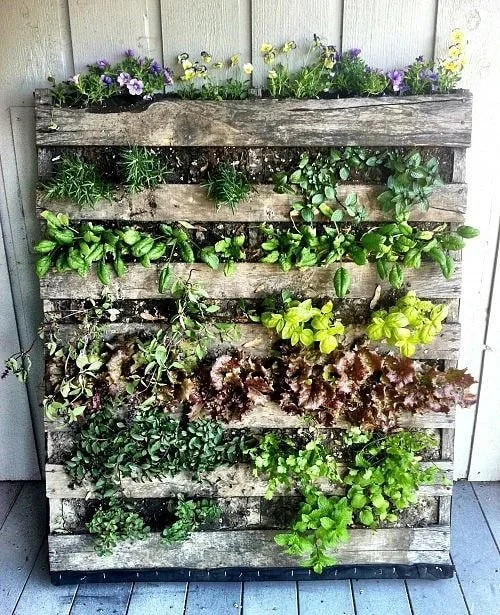
Pallet Living Wall

Old wooden pallet turned into a series of planters, with many different plants growing every which way.

Photo courtesy of Backyard Boss

If you're looking for a way to get a living wall into place quickly, without having to do much building or designing, a pallet wall is a good choice. Get hold of 2-3 pallets from your local hardware store (they're typically willing to just give them away, but be sure to ask.) Once you've got them home, give them a quick run over with sanding paper, a hammer and possibly a grinding saw, to get rid of any rough or dangerous spots. You can paint or stain them if you want, we like the rough wood look ourselves, but it's up to you how much of the pallet is going to be showing. Next is to choose, do you want the wall to be horizontal, making a low wall, or would you rather have one tall section? Keep in mind that both choices are going to affect how you interact with the plants you choose and caring for them. From here go ahead and attach them to your chosen surface.  Some options here for you: you can attach them to your fence, to a wall of your house, or to build a frame for them. Then your final step is to fill them with earth (take your pick here, there are posts that are far better at discussing the differences in dirt and how they affect plants than us) and fill in the openings with the plants of your choosing. We like ivys as they will flow both up and down, and create a very real "wall" given time. 


Using Mortar Screws

Black angled planters attached to a stone exterior wall with suculent plants spilling out of the planters.

Photo courtesy of Angela Rose Home

If a pallet wall isn't your thing, you might consider attaching planters directly to a wall of your house. Make sure that whichever wall you choose is stable and won't be damaged by having mortar screws driven into it. Then get hold of a set of planters you like and a drill. Drill through the planter and set a starting hole into the mortar of your wall. Then get hold of your mortar screw and attach the planter. Like before, your final step is to fill your planters with your choice of dirt and plants. We think this type of planter set up is great for herbs of different types, giving each planter their own space. 


Fencing or Chicken Wire Living Wall

This one is going to sound a bit weird, but if you have ever seen how ivy grows, you'll understand. Make a wall using either fencing, or chicken wire, or a combination of both. Then choose your plant that will twine and grow up said wall. Honeysuckle? Ivy? Hydrangeas? (Yup, they climb!) Nasturtiums or Climbing Roses? All of these, and so many more are options.  All you need to do is to plant them at the base of you wall, and as they grow, weave them through the gaps. With time you will have a full living wall to add to your backyard. 


Chains Attached to or Connecting Planters

If you're looking for something a little more artistic, this might be up your alley. Start by either building a frame, like an upside-down and very square U. Then attach flat bottomed planters to two lengths of chain, one on either side. Our suggestion is to drill through the sides of your planters and use eyebolts along with washers and nuts on the inside. Repeat this process at heights that work for you, making sure to take into account the heights your desired plants should grow to, plus two inches or so. So if you're using succulents that you plan to keep relatively small, you might only need 5 inches or so between the top of one planter and the bottom of the one above it.  If you want something like onions, though, as an example, you need to consider that they can grow as much as 18 inches in height. 


Planters with Hooks

What if you've already got a wall, though? But it's too large for you to try and fill all of it with dirt to plant in? Or if you live in an area that's rather windy, and you need to be able to bring in your plants during poor weather?  In that case, you might consider planters with hooks on them. If you hang them on the bars of your theoretical wall, then you'll have a lovely plant wall that you can even rearrange! 


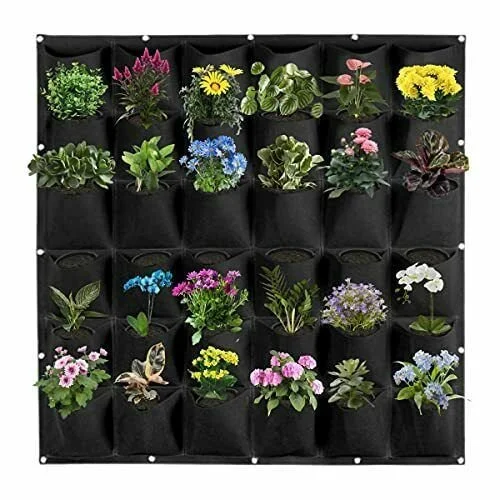
 Hanging Fabric with Pockets

This was one that surprised us, but really shouldn't have. There are so many different inventive ways of setting up a planter wall, that someone decided "instead of heavy planters, I'll use fabric." Yup, imagine a roll of dense gardening fabric draped over a wall or section of wall of your choosing, and then sew row after row of pockets onto it. You can do this one indoors or outdoors, and we've seen some that are only 5 or 6 pockets wide, and we've seen some that are 20 wide. This one is versatile for sure, but we have to question how long it will last with the weight of both dirt and plants, and then any flowers or fruit that those plants might bear. 


PVC Pipe Living Wall

Our final version is for when none of these have been quite right. You want something a little more industrial, a little more colorful maybe. In that case a set of PVC pipes might be up your alley. What you'll want for just one unit is a length of PVC pipe, and two caps. Taking just the PVC pipe, cut out a strip, roughly half an inch wide, running the entire length of the pipe. Now attach the bottom cap, probably using glue or plumber's cement to ensure it can't come off. Fill your pipe with dirt up to the point where you want your first plant, and then carefully place the roots inside the pipe, with the 'plant' portion on the outside and slide it down until you hit your first layer of dirt. Repeat this process all the way to the top, and then apply the top cap. To this one, we do not advise using a sealant, just incase you need to be able to move things around. For that same reason, we don't suggest permanently affixing this to the wall, and instead using a different system of your choosing to fix it to the wall. We like the idea of screws similar to what you would find on  a picture frame, but larger. The best thing about this sytem is that you can paint the PVC any color or design you want. Want zebra stripes? Go for it. Aged copper? You've got it! Making it look like something you scavenged out of a long-lost ruin of a bygone scientific age? The sky is the limit. 


What is your favorite out of these options? Do you have one you want to use in your home or are you still thinking about it? Let us know in the comments below or over on our Facebook page. 


If you're tired of talking plants, though, and just want something that works, we can still help. If you've got an oven that won't hold heat or a washer that leaks, we can help. Give us a call at ((214) 599-0055) or visit our contact page to set up an appointment. We'll work with you to diagnose and fix the problem so that your home can start running smoothly again.  We serve everywhere between Dallas and McKinney, from Coppel to Garland, and we're here to help you.