Orchard Bread, The Whole Year Round

Using different fruits you can make this tasty treat all year and celebrate the turn of the seasons too!

What's filling, sweet, and easy to carry and won't make you feel like you have a car tire around your middle? Orchard bread. Call it fruitbread, fruitcake, cherrybread, orchard bread, whatever you like. The basic concept is the same. Lots of delicious dried mixed fruits + a sweet bread base.  It's delicious, it's wonderful any time of year, and if you wrap it properly, you'll be able to eat it before it turns into a doorstop. 

Ingredients:

3/4 cup golden raisins

3 Tbsp amber rum

3/4 cup all purpose flour

1/2 tsp baking powder

1/4 tsp baking soda

kosher salt

It doesn’t have to be this particular brand, but you want to make sure that it says unsulphured on the bottle so the recipe turns out right.

1/3 C packed brown sugar (dark or light will work, but we suggest light) 

1 1/2 cups packed dried strawberry halves 

1/3 c dried cherries

1/3 c dried cranberries

3 c walnut halves, lightly toasted 

3 eggs

2 Tbsp unsulphured molasses (so this recipe wouldn't work with blackstrap) 

2 tsp pure vanilla extract 

Tools:

small microwave safe bowl, 9x5 inch loaf pan, parchment paper, large bowl, whisk, a small bowl (doesn't have to be microwave safe this time), silicon spatula, tin foil.

To start off, grab your small bowl, and toss in your golden raisins and rum. Cover them with a plate and microwave until their warm, not steaming, roughly a minute. Set that to the side, keeping it covered and check back on it in 15 minutes to give it a stir, and then again at the 45 minute mark. Leave it alone for a further 15 minutes, making it roughly an hour in total. At that point the raisins should have absorbed most of the rum. Drain off any liquor that's left to either use again at another point, or drink it yourself if you're over age. 

Now preheat your oven to 300*F and make sure that there is a rack in the middle of the oven. Grab your loaf pan and parchment paper. Measure out two sheets of parchment paper, one going lengthwise and one going crosswise. You want enough paper here to push down into the corners of the pan and still have 'handles' hanging over the sides. Start from one corner and work to all of the others, slowly smoothing the paper into the corners so that it's flush. Any bumps or wrinkles in the paper or going to lead to bumps or wrinkles in the bread. Use a stick of butter and apply a layer to the parchment paper, making sure to coat everything within the pan. 

Next up, grab your flour, baking powder, baking soda, 1/2 tsp of your salt and then your brown sugar of choice. Whisk all of it together in a large bowl and make sure to break up any clumps as you go. Set aside your whisk and add in your strawberries, cherries and raisins and toss to coat everything. Add in the walnuts and toss again to combine and coat the walnuts. 

Take a clean small bowl and your whisk and beat together the eggs, molasses, and vanilla until everything is well mixed. Now grab your spatula and add your fruit-nut mixture, folding and mixing to combine and coat all of the pieces with the batter. You want to make sure that there aren't any pockets of dry ingredients on the bottom or at the edge of the bowl. Pour the batter into your loaf pan, scraping the bowl to get any remaining bits into the pan. Tap the pan against the counter several times to release any air bubbles, and use the spatula to smooth the top into an even layer. 

Bake the cake for an hour, rotating the pan after 30 minutes. If your bread is browning too much at the halfway mark, you can cover it loosely with a tent of foil. When the top is a deep golden brown, it's done! Remove it from the oven and place to pan on a wire rack to let it cool. 


When it's finally cool, grab the handles you left yourself and remove the loaf from the pan. Use a bread knife and cut it into thin slices and serve. IF you have any leftovers, they can be wrapped well in wax paper and store it in an airtight container for a week at room temperature. 

You can serve it with various butters or fruit jams for a delicious snacks or breakfasts. You could also work up a quick icing with milk and powdered sugar and drizzle it across the top. 

Courtesy of Peggychoucair


So, what do you think? Are you up for doing some experimental baking this weekend? What other fruits would you add into the mix? Let us know in the comments below or over on our Facebook


If you ended up here instead because your stove isn't working properly, give us a call! You can get hold of us at ((214) 599-0055) or by going to our website to set up an appointment that works for you.
7 Ways To Build a Living Wall

How to build your own living wall, to bring plants into your home for a brighter, healthier home. 

This month we're focusing on outdoors-y things, from setting up for a backyard party, to choosing the best grill for you, and a few others. This week's post is focusing on making your space more inviting with a living wall of plants! It's not just a wonderfully popular trend right now, it's also an amazingly useful and restorative concept to include in your home. Having plants around the home has been proven to be good for you body, mind and soul. Not only does having more green around the home help with your health (provided you choose plants you're not allergic to) but it also gives you a sense of peace when it comes to tending them.  With all of that in mind you're probably asking "how do I make a living wall then Blogger?" Fortunately for you, that's just what we're going to cover, 8 different ways you might make your own at home, whether it's outdoor, or in. 


Pallet Living Wall

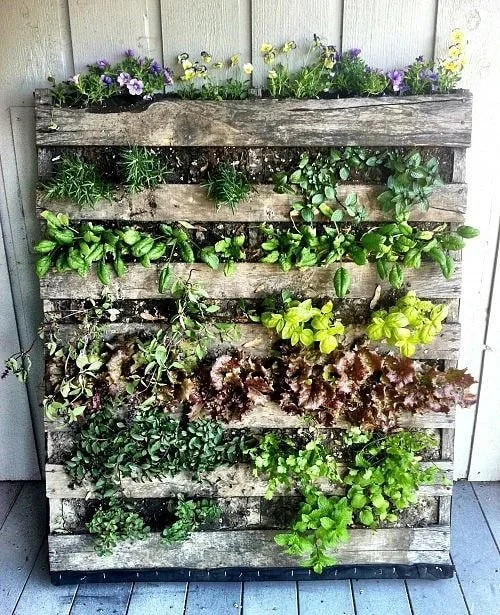
Old wooden pallet turned into a series of planters, with many different plants growing every which way.

Photo courtesy of Backyard Boss

If you're looking for a way to get a living wall into place quickly, without having to do much building or designing, a pallet wall is a good choice. Get hold of 2-3 pallets from your local hardware store (they're typically willing to just give them away, but be sure to ask.) Once you've got them home, give them a quick run over with sanding paper, a hammer and possibly a grinding saw, to get rid of any rough or dangerous spots. You can paint or stain them if you want, we like the rough wood look ourselves, but it's up to you how much of the pallet is going to be showing. Next is to choose, do you want the wall to be horizontal, making a low wall, or would you rather have one tall section? Keep in mind that both choices are going to affect how you interact with the plants you choose and caring for them. From here go ahead and attach them to your chosen surface.  Some options here for you: you can attach them to your fence, to a wall of your house, or to build a frame for them. Then your final step is to fill them with earth (take your pick here, there are posts that are far better at discussing the differences in dirt and how they affect plants than us) and fill in the openings with the plants of your choosing. We like ivys as they will flow both up and down, and create a very real "wall" given time. 


Using Mortar Screws

Black angled planters attached to a stone exterior wall with suculent plants spilling out of the planters.

Photo courtesy of Angela Rose Home

If a pallet wall isn't your thing, you might consider attaching planters directly to a wall of your house. Make sure that whichever wall you choose is stable and won't be damaged by having mortar screws driven into it. Then get hold of a set of planters you like and a drill. Drill through the planter and set a starting hole into the mortar of your wall. Then get hold of your mortar screw and attach the planter. Like before, your final step is to fill your planters with your choice of dirt and plants. We think this type of planter set up is great for herbs of different types, giving each planter their own space. 


Fencing or Chicken Wire Living Wall

This one is going to sound a bit weird, but if you have ever seen how ivy grows, you'll understand. Make a wall using either fencing, or chicken wire, or a combination of both. Then choose your plant that will twine and grow up said wall. Honeysuckle? Ivy? Hydrangeas? (Yup, they climb!) Nasturtiums or Climbing Roses? All of these, and so many more are options.  All you need to do is to plant them at the base of you wall, and as they grow, weave them through the gaps. With time you will have a full living wall to add to your backyard. 


Chains Attached to or Connecting Planters

If you're looking for something a little more artistic, this might be up your alley. Start by either building a frame, like an upside-down and very square U. Then attach flat bottomed planters to two lengths of chain, one on either side. Our suggestion is to drill through the sides of your planters and use eyebolts along with washers and nuts on the inside. Repeat this process at heights that work for you, making sure to take into account the heights your desired plants should grow to, plus two inches or so. So if you're using succulents that you plan to keep relatively small, you might only need 5 inches or so between the top of one planter and the bottom of the one above it.  If you want something like onions, though, as an example, you need to consider that they can grow as much as 18 inches in height. 


Planters with Hooks

What if you've already got a wall, though? But it's too large for you to try and fill all of it with dirt to plant in? Or if you live in an area that's rather windy, and you need to be able to bring in your plants during poor weather?  In that case, you might consider planters with hooks on them. If you hang them on the bars of your theoretical wall, then you'll have a lovely plant wall that you can even rearrange! 


 Hanging Fabric with Pockets

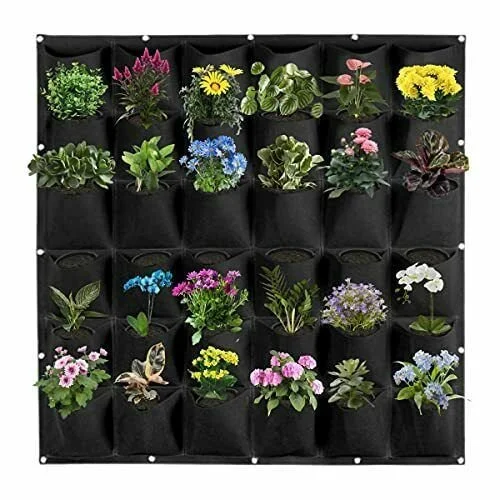
This was one that surprised us, but really shouldn't have. There are so many different inventive ways of setting up a planter wall, that someone decided "instead of heavy planters, I'll use fabric." Yup, imagine a roll of dense gardening fabric draped over a wall or section of wall of your choosing, and then sew row after row of pockets onto it. You can do this one indoors or outdoors, and we've seen some that are only 5 or 6 pockets wide, and we've seen some that are 20 wide. This one is versatile for sure, but we have to question how long it will last with the weight of both dirt and plants, and then any flowers or fruit that those plants might bear. 


PVC Pipe Living Wall

Our final version is for when none of these have been quite right. You want something a little more industrial, a little more colorful maybe. In that case a set of PVC pipes might be up your alley. What you'll want for just one unit is a length of PVC pipe, and two caps. Taking just the PVC pipe, cut out a strip, roughly half an inch wide, running the entire length of the pipe. Now attach the bottom cap, probably using glue or plumber's cement to ensure it can't come off. Fill your pipe with dirt up to the point where you want your first plant, and then carefully place the roots inside the pipe, with the 'plant' portion on the outside and slide it down until you hit your first layer of dirt. Repeat this process all the way to the top, and then apply the top cap. To this one, we do not advise using a sealant, just incase you need to be able to move things around. For that same reason, we don't suggest permanently affixing this to the wall, and instead using a different system of your choosing to fix it to the wall. We like the idea of screws similar to what you would find on  a picture frame, but larger. The best thing about this sytem is that you can paint the PVC any color or design you want. Want zebra stripes? Go for it. Aged copper? You've got it! Making it look like something you scavenged out of a long-lost ruin of a bygone scientific age? The sky is the limit. 


What is your favorite out of these options? Do you have one you want to use in your home or are you still thinking about it? Let us know in the comments below or over on our Facebook page. 


If you're tired of talking plants, though, and just want something that works, we can still help. If you've got an oven that won't hold heat or a washer that leaks, we can help. Give us a call at ((214) 599-0055) or visit our contact page to set up an appointment. We'll work with you to diagnose and fix the problem so that your home can start running smoothly again.  We serve everywhere between Dallas and McKinney, from Coppel to Garland, and we're here to help you.

Ginger-Pear Braised Beef

A dish sure to impress, warm, savory and sweet, all at once.


I Don’t Care, Take Me To The Recipe!


You need something nice enough to impress guests and delicious enough that they’ll remember it rather than be bored by more ‘traditional’ guest meals. The answer? Go old-school. Grab a hunk of beef and cook it with ginger, cider, and pears to give it a delicious, warm taste that they won’t forget, but that hasn't been done a million times over. 


Ingredients: 

3 lbs beef chuck roast, trimmed of excess fat

Kosher salt 

Fresh ground black pepper

2 Tbsp neutral-tasting oil. Ex vegetable, canola, or grapeseed

5 yellow onions, thickly sliced

1 tsp dried thyme, crushed

2 tsp ground ginger

1 ½ Tbsp all-purpose flour

1 cup sparkling hard cider, pear, or apple (although pear is preferred) 

½ cup low-sodium chicken broth

3 ripe (but still firm) Bosc, Bartlett, or Anjou pears

¾ tsp cider vinegar

¼ cup chopped fresh parsley 


Tools Needed: 

Knife, cutting board, kitchen twine, Dutch oven, large bowl, slotted spoon, paring knife, peeling knife. 


Start off by grabbing your pears. You’re going to peel the skin off, core them and then chop them into 1-inch pieces. 


Next, grab your beef and set it on a cutting board. Dry it with paper towels and then tie it into a uniform shape with kitchen twine at 2-inch intervals. So your best bet is to start off by wrapping one long strand around the length of the brisket to get the ‘mid line’ and then going at 2-inch intervals up that, so you end up with something similar to a corset around your brisket. Now season liberally with salt and pepper. 


Take your Dutch oven over to the stove, put it on medium-high heat, and warm 1 tbsp of your oil until it’s shimmering. Add the beef to the pot and cook until it’s deeply browned on the bottom. This should take 3-4 minutes, so set a timer and walk away. You don’t want to bother the meat during this process so that you get an even crust on that side. When the time is up, and it’s reached a deep brown, turn it and repeat this for the other three sides. Remove the brisket from the pot and set it aside in a bowl. 


Keep the pot on medium-high and add the remaining oil, and warm until it’s shimmering. Add your onions and an additional 1 tsp of salt and cook, stirring and scraping the bottom of the pot occasionally until your onions are softening and releasing liquid. (This should be roughly 4 minutes.) Turn the heat down to medium-low and keep cooking for an additional 15 minutes, stirring and scraping the bottom of the pot; turn the heat down as needed so that your onions are simmering and not burning. Seriously, “burn” does not taste good in this recipe. Add the thyme, ginger, and flour and continue to cook, stirring until the onions are sticky and golden, roughly 5 minutes. Add your cider, broth, and ½ tsp salt. Stir and scrape the bottom of the pot to loosen and dissolve any browned bits. 


While that’s going, open up your oven, and move a rack to the lower middle, then preheat the oven to 300*F. 


Add the beef back into the pot, and make a slight ‘nest’ in the onions for it. The onions and aus-jus in progress should cover ¾ of the meat. Put the lid on the pot, place it into the oven and allow it to cook for 1 hour and 35 minutes. After that, you’ll add in the pears, stirring them very slightly into the onions. Return the pot to the oven and continue to cook covered until the beef is extremely tender. This should be roughly 2 hours and 15 minutes more. 


Transfer your beef to a cutting board, and using a large slotted spoon, move the onions and pears onto a serving platter; cover loosely with foil to keep warm. 


Pour the liquid from the Dutch oven into a measuring cup and let it rest for 10 minutes, or until all of the fat rises to the surface. Tilt the cup to the side and use a soup spoon to skim off the fat and dispose of it. (Or, if you’re like us, drizzle it over your dog’s food.) Add the vinegar and most of the parsley to the liquid and stir to combine. Taste and adjust the seasoning with salt and pepper if needed. 


Finally, cut the twine off of your brisket and cut it against the grain into ½ inch thick slices. Place the meat on the platter with the onions and pears, pour the juices over the meat and serve. 


If you’re not sure what to have as a side dish, we’d have to suggest roasted sweet potatoes and a fresh loaf of crusty bread. 


Now that you’ve tried it, what do you think? Delicious, right? Let us know over on our Facebook page. We’d love to hear from you. 


Making Your Home Sustainable

Definitions, Retrofitting and Small Choices to Make Your Home Greener and More Sustainable

Table of Contents

Definition

What does that mean for a home?
Some ways you can achieve it. 

Benefits! 


Do you ever wonder what all of the jazz is about being 'sustainable?' What does it even really mean? We're taking a look at that, some ways to retrofit your home to be sustainable and everyday choices you can make. 

Definition

According to Merriam Webster "sustainable" can be defined as: 

-able to be maintained at a certain rate or level.
"sustainable fusion reactions"
-conserving an ecological balance by avoiding depletion of natural resources.
"our fundamental commitment to sustainable development"

What does that mean for a home?

So your home in theory needs to either be "able to be maintained at a certain rate or level" or "conserve an ecological balance by avoiding depletion of natural resources.  Well, that gives us a start, but it's not really clear is it? After all, once a home is built, you're not doing a ton to bring in new materials, or are you? Let's try looking at it this way. A sustainable  home should be one that's either built or retrofitted in a way that it respects resources and their availability, optimizes energy usage and creation (when possible) and uses water wisely. Sustainable homes use low-impact, high-performance materials throughout, and are efficient in terms of manufacturing, shipping and installation. 

So ideally, whether you're retrofitting your home or looking to build from scratch, your home should "respect resources," optimize energy usage, and use water wisely. With that list in mind, that's considerably more manageable to tackle than trying to redo EVERYTHING from the ground up. Wouldn't you say? 

Some ways you can achieve it.

These are meant to be a guide for you, not a step-by-step outline. If you want more information and more in-depth guides, let us know in the comments and we'll expand on it! 

First off, don't try and do everything at once. Pick one section, list what falls under that section in your home, and then look to see what you can change. Out of everything else that we talk about today, that's the most important one to keep in mind. If you try and take everything on at once, you'll burn yourself out before you get it done. 

Both retrofitting and building new will have drawbacks, so consider carefully before you decide. Make a list of pros and cons to get a better grasp on what will affect your day to day life, finances and family. 


Different things you can look at include:

- Building materials - Sustainability isn't just "are these materials going to last a long time," it's also "how are these materials harvested?"; "How are they made?"; and "how are they used?"

-Building methods - Can you have a cool roof? What about designing your home in a way that allows air to move fluidly through the home? 

- Insulation- You want to look at a type of insulation that is sustainably produced, and is also going to protect your home best from loss of heat and cold. 

-Windows - Again, keeping heat and cold in or out of your home, your windows are a big deal. 

-Heat, ventilation and air conditioning

-Plumbing fixtures

- Appliances -  Energy Star appliances 

- Energy generation from solar and wind- If you can generate power on your own property, you can reduce your bills which is always a win. 

- Your habits when it comes to regular maintenance, conservation and green cleaning


For this post, we'll focus on retrofitting your current home, with the potential of covering building from the ground up later. 

Replacing Windows

-Why - It results in less loss of heating/cooling and makes your home quieter. (Which we absolutely love, and bet you will too.) 

-How - Look for windows that are tagged "low solar gain." This means less heat is conducted into your home through the windows. Reflective tech and double glazing are supremely important for keeping even more heat out. It also doesn't hurt to look at windows you can open on a breezy day. 

Appliances 

-We've talked about the Energy Star Seal before and how important that is to cutting your bills. Investing in appliances that are energy efficient is good not only for the environment but also for your environment as they draw less energy from the grid. 

Ditch Your Sprinkler System

-While we are planning on talking about the benefits of getting rid of a 'traditional' lawn, for now let's consider a drip irrigation system. 

Rather than watering your lawn 2-3 times a day just to keep it green, this is more efficient. Instead of soaking your yard and hoping the water gets to the roots, a drip irrigation system uses gravity to go directly to the roots. You save electricity and water. Double Win. 

Every day changes you can make include the following: 

-Draft proof your windows and doors- Seal them at the edges with foam or tape to help them close more firmly and keep drafts out. 

-Invest in curtains or blinds, or both! - We've talked before about the importance during winter or summer of keeping your windows covered, and it's just as important now. While we know that curtains and blinds are as much a matter of design choice as anything else, using both can help cut down on your bills further. 

-Reevaluate your home's insulation - Whether you go through your attic or basement, or take a look at the building plans for your home, check out what type of insulation was used on your home. It might be a project to tackle one room at a time to improve it and keep your home better insulated. 

-Install solar panels 

-Clean your refrigerator's coils - Keeping your refrigerator clean helps to keep it running more smoothly and staying cool. 

-Clean your dryer vent 

- Clean your dishwasher's filter

-Install a water filter that removes microplastics - Let's be frank, no one wants to eat plastic. Right now it's theorized that each of us is eating approximately enough microplastics to form a credit card, every day. Right now the easiest way to stop that is to install a water filter. Although it won't do anything to microplastics in your food, it's a place to start. 

-Replace fluorescent bulbs with LED bulbs

-Clean out your gutters -Having overflowing gutters will not only affect your home, as we've discussed in the past, but it will also keep water from flowing into your drip irrigation system. 


Benefits! 

-Using less water and electricity, results in lower bills for you! 

- Lower maintenance costs 

Since one of the definitions of sustainability is "able to be maintained at a certain rate or level," a well-built green home is going to last for a very long time. Thanks to construction methods, your home will require less maintenance over time, which means less money spent to maintain it. 

- Lower carbon footprint and better for the planet

A house with a green door has a set of leaves coming out of the peak of the roof  to imply that the home is green and sustainable


Do you think you'd like to go sustainable? What reasons are keeping you from doing so? Drop us a line in the comments below or over on our Facebook page. We'd love to hear from you! 

If you're here because your refrigerator isn't keeping cool, or your dryer is taking forever to run, we can help! You can reach out to us on our contact page or by giving us a call at ((214) 599-0055). We'll work with you to set up an appointment that works for your schedule.

What Brand Has the Fastest Dishwasher?

 Finding out which dishwasher has the shortest cycle time to make your life easier. 

Table of Contents

The Heavyweights

The  Mid-Tier 

The Lightweights

And the  Best of the Best 

Speed is everything when your to-do list is always getting longer. You've got to get dishes done, but it's one of the worst jobs ever, and you want dinner to be on the table by... when? And of course you need dishes in order to make and serve the food. So the dishwasher is one of the workhorses in your kitchen, even if you hate having to load it and get everything clean.  

Fortunately, speed is one of the things that dishwasher makers have been focusing on of late, so let's take a look at where we're at. 

An important note before we go on, all our research has been gathered together from a third party doing extensive testing and research. All dishwashers were tested when set to their basic settings for a normal wash.

The Heavyweight Dishwashers

These are the longest cycles on our list today. Don't let that dissuade you though, as they are also some of our best rated machines as well.  Out of 100 possible points, testing for washing, drying, noise level and energy usage, all three of these scored 70 or higher. (It doesn't sound great, but many machines don't score over 70, and very few score over 90.) Out of these three, the Thermador did the best, with a solid 84 points. 

How well these are rated though, is only one part of why you're here though. You're wondering why you should bother trading off speed for one of these. That is where the points come into it. Although each of these takes roughly 2.5 hours to run a load of dishes, they all do very well at making sure the dishes really get clean. Whether you're dealing with baked on foods, dishes that have been sitting in the sink all week, or that coffee cup you forgot was in your office, all of these are great for tackling built up food. That's where the trade off often comes in, of speed versus depth of cleaning.  

The Thermador dishwasher did the best at getting baked on food cleaned off, as well as being energy efficient. We also loved just how much you could fit into it at one time and that it displayed the remaining amount of time left in the cycle.

Cafe CDT805P2NS1 - $983 - 155 min 

Thermador DWSD650 - 1399 - 155 min 

Whirlpool WTA50SAKZ - $759 - 150 min 

The Mid-Tier Dishwashers

Let's move on to the mid tier selection. Here we've shaved off ten minutes on the standard time for the cycle length. Both the LG and the Kenmore are 24 inch counter depth dishwashers.  The LG would have actually scored higher than the Kenmore if it wasn't for the known issues over time that many owners cite with LG products in general. We love the True Steam function as well as the adjustable racks and we're especially pleased by the Energy Star certification. 

LG LDT7808BM - $1200 - 145 min 

Kenmore 14573 - $845 - 145 min

The Light weights

Next up, we have some of the fastest dishwashers on the market as of right now.  If you notice, all of them are just over 2 hours and all of them are under $1000. The question that we have to ask, which is the best of the four?  After looking all of them over closely, the Ikea Essentiell is surprisingly the best. It does the best at both washing and drying the dishes, as well as being very efficient with energy. The biggest issues for us were that it was noisy and the interior coating is plastic. As we've mentioned in the past, having a plastic coating can be problematic over the life of the dishwasher. This is a fantastic dishwasher if you're looking to outfit an apartment or rental property as it's cheap, energy efficient and very good at getting things clean. 

KitchenAid KDFE104HPS - $854 - 135 min 

Ikea Essentiell (80.655.85) - $580 - 135 min

Thor Kitchen HDW2401ss - $899 - 130 min 

Samsung DW80K505OUS - $600 - 130 min 

And the Best of the Best 

Bosch Ascenta - 595 - Cycle length 95 min 

Drumroll please, here we have the best of the best, the fastest dishwasher available on the market right now. We've got the Bosch Ascenta at a cycle length of 95 minutes. That's an hour and 35 minutes. You can get everything washed in the time it takes you to make a good meal.  It also scores the best out of all of the dishwashers on the list of 88 points. It scored the best on washing, drying, noise level and customer satisfaction. This is Bosch after all, and as we've seen in the past, they make very reliable appliances. 

What we wanted to know was, "what makes a dishwasher fast? What are they giving up by being faster?" 

Most fast dishwashers give you adjustable settings so you can choose a shorter cycle at the expense of a through cleaning. But the research shows that that's not the case with the Bosch Ascenta. As we said earlier, all of the dishwashers are tested on a standard cycle for their speed, washing and drying capabilities. And after digging around and finding nothing, we have to assume that the information for what makes a dishwasher fast is proprietary.  It might have something to do with the speed of the internal water jets, or the temperatures that the water is heated to. Let us know what you think it might be, or if you have any insight! 

With all of this in mind, let us know which one are you most interested in? Do you value speed or strength when it comes to your dishwasher? Let us know in the comments below or over on our Facebook page. We'd love to hear from you! 

If your dishwasher is giving fits but you're not interested in buying a new one, we can help! Give us a call at ((214) 599-0055) or head over to our contact page to set up an appointment that works for you. Wherever you are in the Dallas area we can help get your home running smoothly again. 


Important note: We have heard about the Thermador Star Series. We didn't include that one on our list because these are the base speeds for the dishwashers, not specialized settings. We will have to do a review of the Thermador at some point in the future. 


Additional Reading

Dishwasher Deep Dive 

What Can vs Can’t go into a dishwasher 

Help I melted plastic in my dishwasher(!)