Raisin Bread for Non Raisin Lovers

When You Really Need To Use Up The Raisins You Have, But Your Family Doesn’t Like Them.

Sometimes the weather is hot and unhappy, and it makes you miss your fall and winter foods. That's what's happening for us this week, so we decided to make some raisin bread.

There are a million and a half recipes for raisin bread. We're not going to get up on a soap box and tell you ours is better because... or ours is different because... That seems a little off the point, if nothing else. Your family may already have a standby recipe for this - but if not, you're welcome to try ours out!

Ingredients:

2 1/2 cups flour

1 cup water, warm 

3 teaspoons active dry yeast

1 teaspoon salt

1 teaspoon white sugar

1/3 cup brown sugar

2 teaspoons cinnamon

1/2 teaspoon clove

1 teaspoon oil (we use olive, but sub whatever you like)

1/2 cup raisins, separated so as not to clump

Tools:

mixing bowl

measuring cups and spoons

spoon

parchment paper or silicone mat

kitchen towel

dutch oven or covered oven-safe pan

thermometer

While we know thermometers are not ubiquitous kitchen tools, we strongly advise using one instead of guessing on water temperature. Instant-read digital thermometers are only a few bucks at your nearest big box store. They are absolutely a justifiable expense, between food safety uses (ensuring meats are fully cooked) and baking tasks (like checking water temperature to proof yeast).

Before you get going, it's a good idea to heat up your water. You can run the kitchen tap until it's warm, or you can measure the water cold and heat it in the microwave if your measuring cup is microwave safe. We normally just measure cold water from the tap and zap it in the microwave for 30 seconds or so. Use the thermometer to check the temperature - it should be no colder than 105 degrees and no warmer than 115. Target 110 as the ideal temperature. If it's too hot, it will kill the yeast - but if it's not warm enough, the yeast won't do its job.

Once you're sure the water is the right temperature, mix in the teaspoon of sugar and add the yeast. Give everything a stir (the sugar will partially dissolve, and the yeast will saturate) and let it sit for at least five minutes. You'll know you did it right when the yeast bubbles and begins to increase in size.

Measure your flour, salt, cinnamon and clove into the mixing bowl and use a spoon to combine them. Add the brown sugar and make sure to stir it in - we know there will be some clumps at this point, but it's okay.

Stir in the raisins at this point, making sure they don't go in as one big blob that won't distribute through the dough. We often task a little helper with making sure they're not too stuck together.

Add your oil and the yeast/sugar/water mixture. Stir until you have something that sort of resembles dough - it'll be shaggy and have what look like huge pockets of flour, but don't panic. Get the spoon out of the way and finish the mixing and kneading process with your hands. Don't be afraid to get a little messy on this one (if you really hate the mess, remove jewelry and/or use gloves). Knead until it's mostly smooth and all the flour has been worked in.

Cover the dough with a clean kitchen towel and allow it to rest for an hour or so. Definitely set a timer. Please don't ignore it for four or more hours as we have accidentally done on occasion. Leaving it to rise too long yields a beer-y sourdough flavor that does not complement the raisins.

After the hour is up, preheat your oven to 375. Turn the dough out onto a piece of parchment paper. Knead it a bit more, with the goal of shaping it into a ball. If it's sticky, add some flour to the dough or to your hands, but avoid overdoing it. No one wants chalk instead of bread.

Now pick up that whole piece of parchment paper and plop it into the dutch oven. Put the lid on it and slide it into the oven on a middle rack. Let it bake for 45 minutes, covered. When your timer goes off again, remove the lid but leave the bread in the oven for another 15 minutes.

Around this point it will start to smell "done." Trust your nose. When it smells like bread instead of almost-bread, it's ready. Remove it from the oven and let it cool. Letting it cool is only really important if you want neat slices - if you're fine with them looking a little crumbly and rough around the edges, just go for it. We find it best served toasted and with a little bit of butter.

Let us know how your recipe turns out, we’d love to hear from you over on our Facebook page. 


And if you’re looking to learn more about how we can help you with your appliances, please let us know

Industrial Chic: Transforming Your Space with Rustic Elements

Maybe there’s another way to look at old spaces?

Industrial Decor comes from the '90s as many City centers in North America started transitioning their shut-down warehouses and manufacturing plants into condos or apartment buildings. Instead of trying to pretend that the building hadn't previously been a warehouse, they would feature the details. Industrial Decor became known for preserving that grungy open and exposed feeling. This type of design is mostly about obtaining a cold, eerie look. Rather than something to gentrify, this became the selling point for many of these new homes.


The great thing about industrial decor is that you don't need to have purchased a warehouse to achieve the look. With a bit of outside-of-the-box thinking, you can manage this even in the middle of suburbia. 


 The key elements of industrial interior design include:


A Mix Of Grays, Neutrals, And Rustic Colors 

As is with many different styles, you'll want to start by building up your color palette. While heading straight to Black or White might seem the obvious choice, more natural and worn colors are really what you should look at. If your space has a lot of room, go ahead and utilize an accent wall in some of the darker tones like charcoal gray, or a deep brick, or umber. If on the other hand your space is a little smaller or maybe the ceiling isn't particularly high, go ahead and use something like a light gray rather than straight white. This will give it the open effect, but it won't detract from the look you're trying to gain. You would also be surprised by the amount of blues, charcoals, and brick tones that you can bring in with this decor style.

An example of some options for an industrial design.


A Raw And Unfinished Look 

Courtesy of Abo Adam

Now that you've got your color decided on, let's make the room look unfinished in order to eventually give it a finished cohesive look (haha). What we mean by this is if your room has molding or baseboards? Get rid of them. If you've got a brick or stone fireplace that maybe was painted at some point, strip it down. If you've got wall to wall carpeting and you know you've got wood floors underneath it, rip it out and it was a little bit of oil you'll have an amazing floor. As with many things in our Decor series, these are options. All of these add to the look of a piece being unfinished, but it's up to you decide what you want to go with.

 Concrete Flooring 

Courtesy of Max Rahuboviskiy - Check out the concrete floor!

Given how many of the original industrial buildings would have been floored in concrete, this is a staple of the look. However if you cannot or do not want to rip your house down to concrete floors, there are other ways to achieve the look without having to destroy your house. You can instead get tiles that look like concrete. You can get peel-and-stick flooring for the same look. You can even lay down a vinyl wrap to achieve what you want. Each of these gives you different amounts of flexibility and ingenuity based on your budget and needs.


 Utilitarian Objects 

   Utilitarian objects are ones which serve their purpose without a lot of extraneous detail or ‘fluff’. There is still a sort of austere beauty to pieces that are simple. They bring joy in their simplicity or in how well they do their job. You can balance this by bringing in pop or abstract art and plant life to bring color and detail to a room. 


 A Use Of Old Vintage Factory And Lab Pieces

Courtesy of Farida Najafguliyeva

 If you want to bring in something special, you might look at incorporating antique or vintage factory and lab pieces. You can often pick them up from sales or thrift stores if you happen to live in the city.  Additionally, you can often find some of the classic fixtures and "Edison bulbs" at hardware stores that carry interior lighting. Cogs and gears are often thought of, but you should look beyond that. Look for pieces that can serve a purpose in your home now, such as repurposing an old chain to hold plants or a table top to act as the backing for a mirror. (Of course there are many more options that we could come up with right now, but these are ones we’ve seen.) 


 Large Sectionals 

Courtesy of Olena Bohovyk

Because of the large amounts of space within many transformed warehouses, bigger furniture was better. Being a sectional just means that you can easily take it apart and move it how you want, whether that’s several small seats or one giant couch for everyone to pile onto. 


 Wood And Metal Surfaces 

Courtesy of My walking Diary

Just like the floors and walls were often left bare, you might want to bring in very simple furniture to reflect the same. This is also a good choice if you’re not living in a converted warehouse and want to get the look anyway. Using reclaimed or recycled wood paired with metal piping to construct tables and shelving is a good example of how this can be achieved.  Using antique light fixtures with metal finishes is also something that is very common and fits well with the look. 


As always, we hope that you enjoyed our take on this aspect of home decor. Will you take on an industrial design at some point? Let us know why or why not over on our Facebook page.


If it is not your love of decor but instead your hatred of your malfunctioning dishwasher that has brought you to us today, you're still in the right place. At Appliance Rescue Service, we take care of all major appliances and work with you to get your home running smoothly again. When you reach out to us via our contact page or by giving us a call at ((214) 599-0055), we'll work with you to set up a time and date that works with your schedule to send out one of our experienced technicians. Whether you live in Plano, Carrollton, or Garland, we want to help.


Why Is My Oven Smelling So Strange?

4 Common Smells You Need To Know

What do you do when you start encountering weird smells in your kitchen? You would start by taking out the trash; after all, that's one of the most common sources. Maybe it has been a few days since you took it out last... But it keeps smelling. So then you start to look around and go section by section. 

Is it coming from the refrigerator? 

Did a potato roll to the back of a cabinet? 

Did the beer you were experimenting with brewing go off? 

No …it's coming from your oven. So what are you supposed to do? The first step is figuring out what sort of smell it is. Then you figure out whether it's something you can solve on your own or call in a professional of one stripe or another. 


Common Smells To Come From Your Oven

- gas

- urine

- dead things

- smells like burning plastic


Why Does My Oven Smell Like Gas? 

Before you start worrying, having your oven smell like gas when you first turn it on, provided it is a gas oven, is normal. So long as it goes away within the first few minutes, you're fine. This just means that the gas is igniting, and it's during that turning-on phase. If, however, the smell continues after 10 minutes or so or continues for the entire time the oven is on, it can mean that not all of the burners in the oven or igniting. If that's the case, then you'll need to get hold of a technician. This isn't something you can fix on your own. Trying to fix a gas oven solo is extraordinarily dangerous. The flammable gases that run through your oven can very easily asphyxiate you if you're not careful when dealing with them.


Why Does My Oven Smell Like Urine? 

If your oven smells like urine, the most common reason is that you have rodents living near or inside your oven.


Courtesy of DSD

For this situation, we suggest calling an exterminator first to get rid of the rodents, then carefully go in and clean all of the inside of the oven. If you can, your next step is to carefully pull your oven away from the wall to see if you can't find where the rodents came in from and if they got inside the oven itself. Be careful with this step, as you don't want to damage your oven or leave a gas line open accidentally. Finally, we suggest calling in a technician if only for your peace of mind. You can tell them that you had rodents and want to ensure that none of the wires or components were chewed on and that the oven will still function as needed.

Why Does My Oven Smell Like Death?

Courtesy of Juan Vargas

Right off the back of the last one, if your oven smells like death, it is most probable but unfortunate that something died in your oven. The same steps still apply, except you really want to call a technician this time. The difference here is that your oven needs to be gone over to ensure that nothing is left inside of the oven. If something dies inside your oven, you have to worry about other creatures attempting to get inside your oven to devour them. Not only is this damaging your oven, but more importantly, if any of that catches on fire, it will be very dangerous for your food and health. 


Why Does My Oven Smell Like Melted or Burning Plastic? 

If your oven smells like melted plastic, you can have several different issues going on. 


The easiest to fix is that there was some residue left over from the last time you cleaned your oven. With that, all you have to do is wait until your oven cools off and then go back in and wipe everything down with a damp rag. 


Courtesy of Ksenia Chernaya

A second possibility could be that you did melt plastic. Perhaps you left a bit of film on a freezer meal, or there was a piece of plastic residue that you missed when you cleaned again, perfectly normal and easy enough to fix.


The last case, however, is the one you hope, and we hope, is not the case. Sometimes if you're smelling burning plastic, it can be because of damage to electrical components or an electrical short. Milton cables and damaged cables smell terrible. 


In the event that you do smell melting plastic, the first thing you should do is turn off the oven. From there, allow it to cool off, then carefully unplug it and assess the situation. For the first two, you can easily handle those. If you ruled them out, however,, you'll need to call a technician to assess the oven and determine if it is due to electrical components.


Hopefully, we have put many of your fears at ease. If you have found your oven smelling strangely and it's not something we addressed here, please reach out to us over on our Facebook page.


If you found your oven smelling strangely and it is for one of the reasons we listed where a technician is required, we would be more than happy to help. You can reach out to us via our contact page or by giving us a call ((214) 599-0055). If you choose to work with Appliance Rescue Service, know that our goal is to get your home running smoothly again. Will work with you to find a time and date that fits your schedule before sending out one of our experienced technicians to find and address the problem.  


Why Is My Refrigerator Making Weird Noises!?

Four Common Sounds Your Refrigerator Can Make And What They Mean


So your refrigerator is making funny noises; your first question is going to be, why. Whether your fridge is knocking, gurgling, buzzing, or humming, all of them have been encountered before. That's the bad news. The good news is that we can answer why it's happening and tell you if it can be fixed.


If Your Refrigerator is Buzzing


If your refrigerator is buzzing off and on, the most likely cause is the water lines for your ice maker. Pay attention to when the buzzing is happening. If it happens for a short period of time when your fridge is drawing water, that's normal and not something to worry about. If you notice it is being abnormally loud when your fridge is drawing in water, you might have a calcium buildup in the ice maker pump. 


If your refrigerator is buzzing near consistently or all the time, the compressor might be the problem. A quick test you can try is to unplug the fridge and then plug it back in after about 5 minutes. If that doesn't fix the issue, you can do one of two things: call an experienced technician to check the compressor, or if you're comfortable, you can check yourself. What you'll need here is a multimeter. You'll check to see if the compressor shows an open circuit. If it does, the issue is something else, and your compressor works fine. If it doesn't show an open circuit, your compressor will likely need replacing. 


If your compressor is fine, the condenser coils are the next place to look. These can easily become dirty or frosted over. Again we suggest unplugging the fridge; only this time, you're going to vacuum the area around the coils. Once you turn the fridge back on, keep an eye on it for several hours to days for any additional noises. 

Original image courtesy of cottonbro studio


 If these have yet to solve your problem, then the final place to check would be the condenser and evaporator fans. Again it might be debris that is causing an issue. Start by unplugging your fan, finding where the fans are located on your fridge model, and vacuuming away debris. While you have it unplugged, you might also look at turning the fans by hand. If they catch or can't turn the entire way around, they might need to be replaced.


If Your Refrigerator is Humming or Vibrating


There's a distinct sound difference between humming and buzzing, and the causes for this are also distinctly different. The most common cause of vibrating or humming for your refrigerator is that it needs to be leveled or that it's pressed too closely against the wall. If that's the case, it's quite easy to grab a level and check that and then pull the fridge away from the wall that it's closest to. 


Another possibility is that there are debris caught near the fans. If the humming is coming specifically from the back of your fridge, you should vacuum that out. It's not uncommon in many households for this to be the issue. Not because people don't vacuum regularly but because most of us don't think to vacuum behind our refrigerators.

Original Image courtesy of cottonbro studio


An utterly benign reason is that your refrigerator is settling into the best speed in order to keep itself cool. So while you should keep an eye on the frequency or harshness of the humming, it doesn't mean straight away that there's a problem.


If Your Refrigerator is Knocking or Rattling


If your fridge is knocking or rattling as though you're in the area of a fracking operation or an earthquake, your fridge might be off balance. This is the most common problem with this sound.


A close second, however, is making sure that you don't have anything heavy on top of the fridge. If your roof of the fridge is being pressed down by a heavy object or many objects, the water lines can be pressing against it and causing a rattling sound. In general, we advise keeping heavy items away from the top of your refrigerator.


Original Image courtesy of =Max Rahubovskiy

The final point is that if you hear the knocking constant, you should call a technician as soon as possible, as it means the compressor is most likely going out.


If Your Refrigerator Is Gurgling


No, it is not the creature from the Black Lagoon; it's your refrigerator. 

If you only hear a little bit of gurgling or trickling, but you're not finding a puddle under your fridge, it's okay! This is actually a normal sound. What matters more is if you hear the sound and then find a puddle.


The first reason you might hear gurgling is the coolant or oil dripping from inside of your compressor from top to bottom. As long that is not leaking out, you're in good shape. If you notice it leaking, call a technician as soon as possible, as the compressor most likely has a damaged casing or is about to go out. 


Original image courtesy of cottonbro studio

 The second reason that you might hear gurgling is that water can drip on the inside of the refrigerator due to its normal defrost cycle. It won't have any long-term effects on your fridge. However, if you start to notice lots of water pooling, you might have an issue with frost forming, and your refrigerator is kicking into defrost more often than normal to compensate for that. To fix that, we suggest removing items from your fridge or freezer and making sure that you're not blocking any events or temperature sensors before putting anything back in. If the problem is still happening after you've gone through that, that's the time to call a technician.


So the next time your refrigerator starts to make a strange noise, Don't panic right away. Instead, consult our guide to find out what type of noise it is and what are some of the things you can do to possibly solve the problem on your own. This way, in the event that you do have to call a technician, you can say that you did try before having to call in the experts, and you might be able to save yourself a bit of money. 


What is the weirdest noise your refrigerator or another appliance has made? Tell us in the comments over on our Facebook page! 


If your refrigerator is giving you trouble, though, and you aren’t comfortable working on it, not to worry! Appliance Rescue Service will work with you to set a time and date that works with your schedule. If your refrigerator is making weird noises, we want to help. You can reach out to us by giving us a call at ((214) 599-0055) or by setting up an appointment through our contact page. 


Pepperoni & Canadian Bacon Stromboli

The most delicious recipe you’ll make all weekend.

Sometimes you really want a pizza, but you don’t have a good place nearby, and you don’t need to make a giant pie. The answer is stromboli. Stromboli is a wonderful food for when you’re going out, as it’s very much like a hand pie, even if ‘out’ is just heading out to enjoy your yard. As with most recipes we share, these are influenced by your Blogger’s history, as a stromboli is a very Philadelphia thing. 


Ingredients:


1 packet pizza dough mix or 1 pound premade dough

(if packet: 1/2 cup water, hot, and 1 teaspoon oil, or as directed)

1/2 pack pepperoni

4 slices Canadian bacon

1/3 cup pasta sauce

1 cup shredded mozzarella

1 tablespoon butter

grated parmesan


Tools:

mixing bowl

spoon

parchment paper and/or aluminum foil

knife

baking sheet

spray oil

small heat-safe dish

basting brush


This recipe can be very messy. If you end up wearing some of it, no worries. It just means you've done it right.


To get started, either work your premade dough until it's soft and pliable, or mix together your dry ingredients, water and oil in a mixing bowl.


If you're making the dough, we recommend stirring it with a spoon until you get a shaggy, lumpy approximation of a dough ball - then knead by hand until you reach the desired consistency. If it's very sticky, add a little flour a spoonful at a time and work it in. If it's dry, add some water the same way.


We would like to take this opportunity to remind you that a little tackiness to the dough is actually helpful, and stops your stretched dough from rebounding immediately.


Working on a sheet of parchment paper is optional, but we find it to be extremely helpful, especially when transferring your finished product to the baking sheet. Feel free to make your own decision here. Some people prefer a clean countertop, some use a board or silicon mat, some (us included) like a piece of wax or parchment paper.


Turn your dough out onto your preferred work surface and make sure you've broken up any lumps to create a smooth ball of dough.


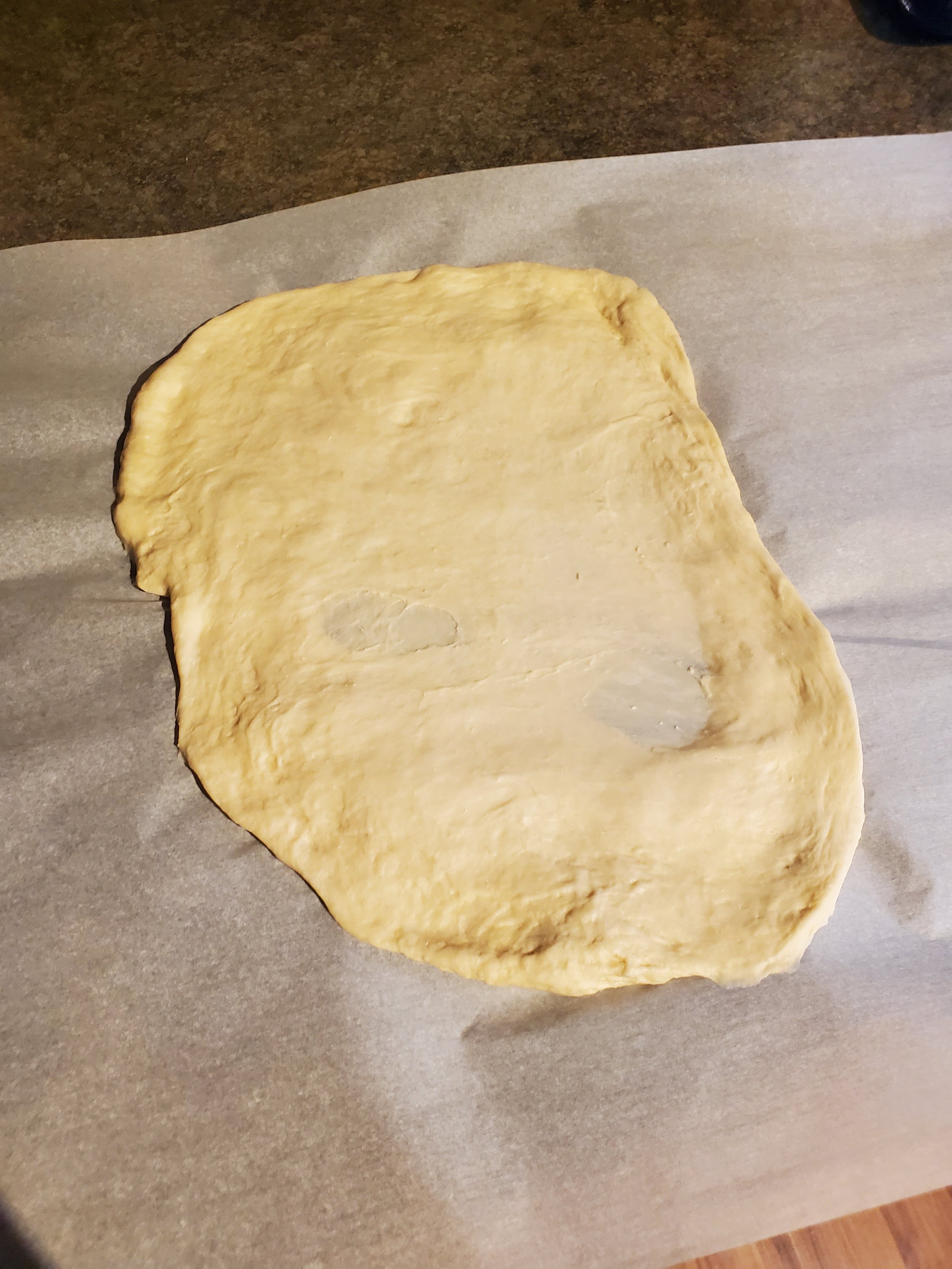
Your next step will be to shape this dough. You can make it a circle like you're working on a pizza, but we find a slightly more oblong or ovoid shape to be easier to work with when it comes time to fold it over. You can work the dough into a circle or oval right away if you like, but we often cover it with a clean kitchen towel and allow it to rest for ten minutes or so before we proceed.


If you're letting the dough rest a little, this is an excellent time to preheat your oven to 375. And if you prefer smaller pieces but have purchased the large slices of canadian bacon (the situation we found ourselves in), it's also a good time to grab a knife and chop those big slices up.


After you've stretched the dough out and it's staying where you've put it (which is why we mentioned a little stickiness being useful), kind of eyeball the halfway point of your shape. Spread a thin layer of pasta sauce on one half, and then add cheese and pepperoni and canadian bacon on top of the sauce. Be sure to leave yourself a little margin around the outer edge of the dough. You'll want plenty of filling there, but you also need to seal the two halves together into a half-moon shape before baking. Pasta sauce makes the dough too slick to seal, so if you drip some too close to the edge, be sure to wipe it up. Nobody wants all that melty cheese to ooze out the sides and go to waste.


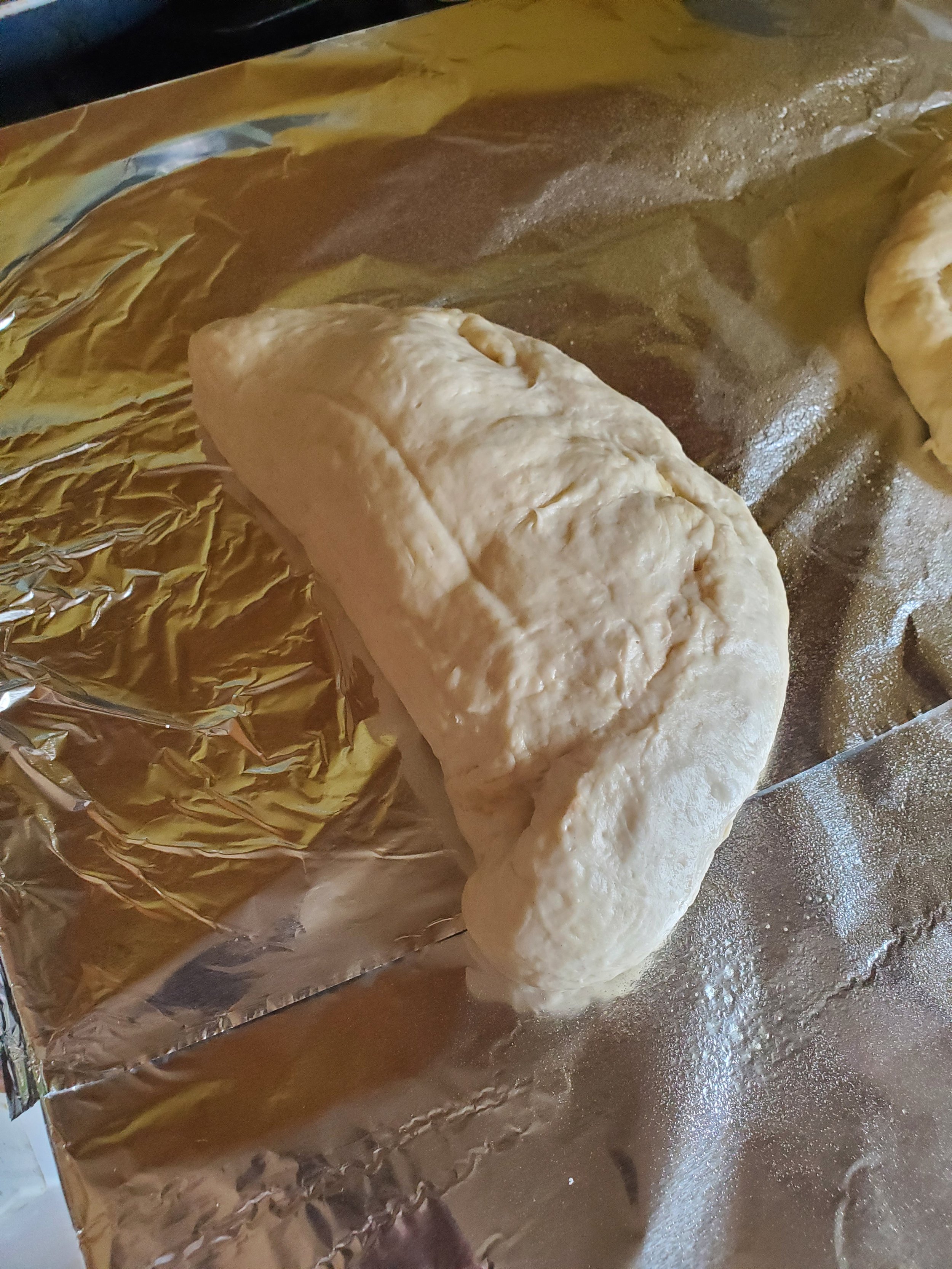
Make sure you work all the way around the open edge, pinching the dough together and folding that pinched portion underneath the bulk of the stromboli. Folding it under ensures the weight of the dough and filling will hold the seal together instead of just hoping for the best.


Now you've got a lumpy looking half-circle of dough. It doesn't look very appetizing at the moment, we know. But don't fret, your final product will be beautiful.


Place a sheet of parchment paper or aluminum foil on the baking sheet. If you're using foil, give it a quick spritz with some spray cooking oil to be sure you don't leave the whole bottom of the stromboli on the baking sheet later.


It's time to transfer your dough to the baking sheet - if you've worked on some kind of mat, board or sheet, pick the whole thing up to avoid opening up your seal. Turn it over onto your outstretched hand, and then flip it onto the baking sheet. 


If you've worked directly on the counter, make sure you lift gently all the way around the edges before you try to pick it up, and support as much of the center as you can. The dough will stretch quite a way before it breaks, but there's no saving a stromboli with a hole in it without making a whole new ball of dough.


After you have the stromboli on the baking sheet, put it into the oven for 15-20 minutes.


Put that little bit of butter into the heat-safe dish and stick the dish somewhere close to the oven vent. This will allow the butter to melt without using any more energy than you already have to (and also prevents popping everywhere, like heating it in a pan or the microwave can sometimes cause).


Check in at the 15 minute mark to be sure your oven isn't overzealous today. Once the top of the stromboli changes color to lightly golden, turn the oven off. Pull the baking sheet out of the oven and use a basting brush to coat the top of the stromboli with melted butter, then dust with parmesan cheese (you can also add herbs here, if your family doesn't panic at the sight of green things). 


Put the whole thing back into the oven for five more minutes, even though the oven is off. We just want the residual heat in the oven to melt the cheese into the butter so it sticks to the stromboli.


After the five minutes are up, remove your meal from the oven and let it cool a few minutes before serving.


Let us know what you think about this delicious meal over on our Facebook. We’d love to hear from you!