Dishwasher Deep Dive

How does it work, why does it work and how can you break a dishwasher?

Table of Contents

Types of Dishwashers

  • Built-in

  • Portable

  • Drawer

  • Countertop

  • Integrated

Dishwasher Sizes

  • Full size 

  • Slimline

  • Compact

Dishwasher Features

  • Sound Reduction

  • Sensor Wash

  • Steam Prewash

  • Flexible Racks

  • Stainless Steel Interior

  • Plastic Interior


For many of us, having the option between a dishwasher and hand washing all of our dishes is a no-brainer. We’ll take the dishwasher any day. So, what happens if your current dishwasher breaks? As in we’ve come to your home, done everything we could and told you that the price to repair it would be more than replacing  it. Well, at that point, you might as well let your inner shopper out and go trawling websites to find that new dishwasher you were considering. This week we’re looking at what varieties dishwashers come in and what features you might see. Let’s dive in. 


Types of Dishwasher


Built-in Dishwasher

 A built-in dishwasher is the most common type of dishwasher in the modern American household. These are the ones that go under your bench or counters. These are built into your wall, piping, drainage, and all. Naturally, this means that they don’t move easily, if at all. (Apologies to those of you that love to rearrange your homes on a regular basis.) Two upsides to that fixed position though: 

-The noises are muffled by the surrounding cabinets and their contents. 

- Since they’re in the kitchen, they’re central to the cooking and dining process, making for easy access and clean-up. 


Portable Dishwashers

Portable dishwashers are a great option if you’ve got a more empty or pared-down kitchen. They’re freestanding devices that you can move around anywhere you need. They can provide extra countertop space when you need it, such as if you’re doing a lot of food prep. They work anywhere, and you can connect them to water and drainage. These are ideal for a couple or if you’re living on your own, as they are better at handling small loads. 


Drawer Dishwashers

Although we mentioned them in our tiny home post, we have yet to touch on these in-depth. Drawer dishwashers are relatively new to the appliance scene compared to built-ins. Instead of opening down and out, they pull out like a sliding drawer. They are very easy to use for those with difficulty bending as they load from the top. 
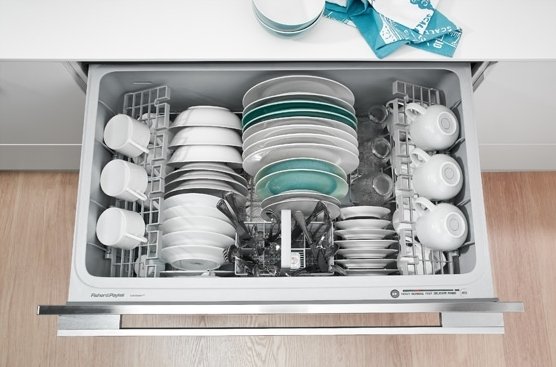
Open drawer dishwasher.

An open drawer dishwasher, showing multiple levels and space for six place settings.

They’re ideal for smaller loads, although they do come in single or double drawer formats. No matter which size you choose, they are still not as spacious as your standard built-in of today. 

One major downside is that because they are such a new concept, makers are still in the process of working the kinks out. Drawer dishwashers are harder to clean, more expensive, and are more prone to breakage than traditional washers. 


Countertop Dishwashers

A compact dishwasher on the counter.

A compact dishwasher on the kitchen counter, along with the rack sitting off to the right.

The supremely shiny countertop dishwashers are a very new concept. They come in several different sizes, but are still smaller than a drawer dishwasher. They don’t need to be builtin and can be moved around very easily. They don’t even need dedicated water o drainage and can instead be hooked up to your sink. 

They use very little water and so are ideal for places with ongoing water shortages. Due to their size, they may not be able to handle all of your pots and pans and probably not the majority of calderas or woks. 


Integrated Washers
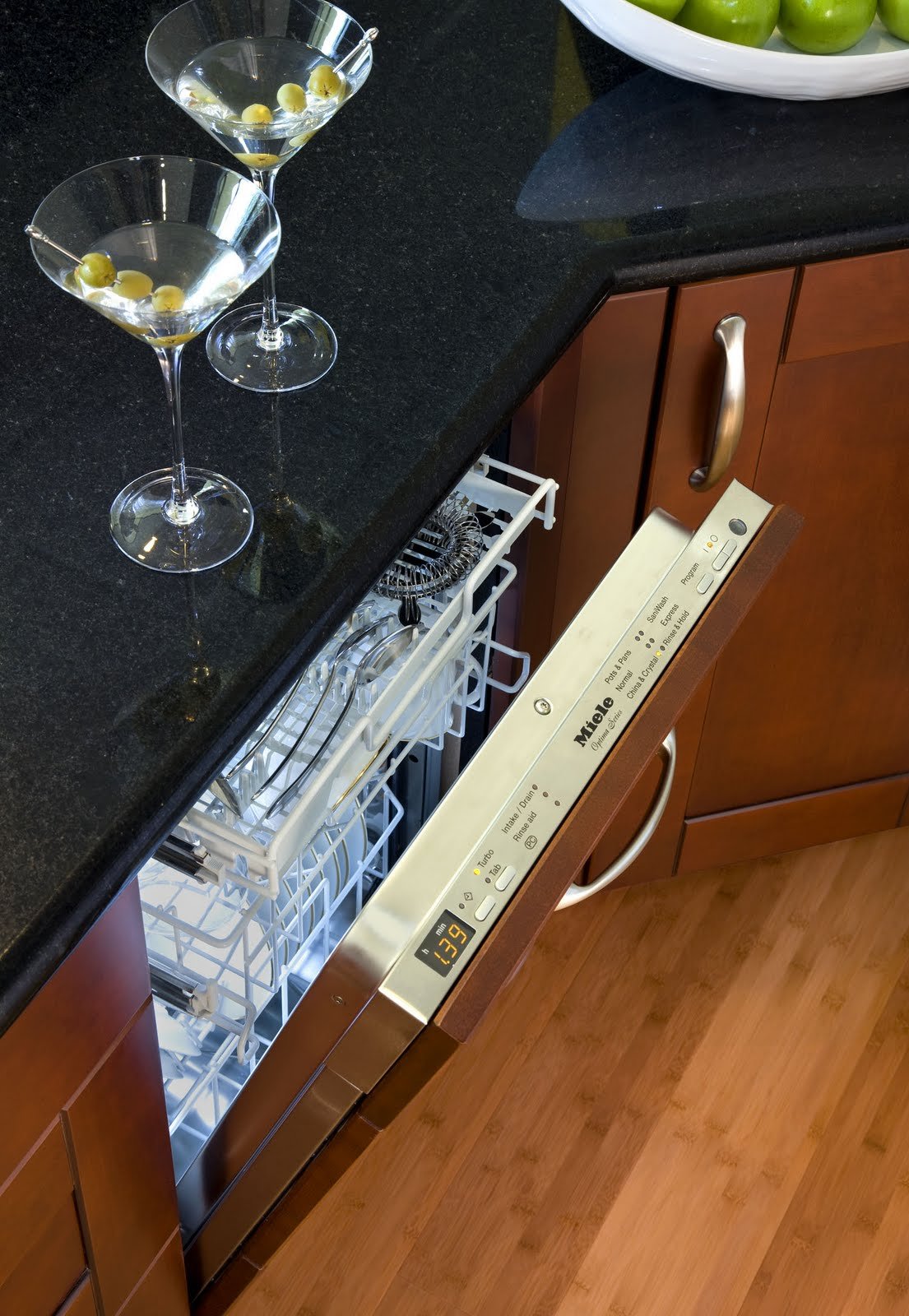
A fully integrated dishwasher in the home.

A fully integrated dishwasher in the kitchen, with the control panel shown off. You can’t see the cabinetry panel as well, but you can see the drawer pull and the staining of the panel which match others within the kitchen.

Our last category of washer types is not based on size or shape, but on how wel it disappears. These are designed to fit in with a very uniform kitchen look. An integrated dishwasher might come with or be ready for panels that match the cabinets in your kitchen. They are built into the cabinetry, much like the built-ins are, but they are split into two categories. Either a ‘fully integrated’ dishwasher or a ‘semi integrated’ dishwasher. A fully integrated unit won’t be any different from a normal cabinet in appearance and instead will have all of your controls on the inside of the machine. A semi-integrated dishwasher on the other hand will have the control panel on the outside but it will still have the cabinetry panel as well. 


Dishwasher Sizes


Now that we’ve looked at the different types of dishwashers let’s quickly look at some of the most common size-related terms you’re likely to encounter. 


These are going to be applied to your built-in dishwashers, although not always. For that reason, we advise carefully checking descriptions before you purchase. 


Full Size

These are the most common variety of dishwasher. They’re designed to hold between 12 and 16 place settings at once. The idea is to cut down on how often you’re running the dishwasher by doing the largest load possible at once. These will usually measure in at 24” wide, 24” deep, and 35” high. 


A slimline dishwasher with an additional third rack.

Slimline 

Take the full-size dishwasher and shave off 6” or so. That’s a slimline. Measuring in typically at 18” wide, 24” deep and 35” high, they are great for a galley kitchen. 


Compact
A compact dishwasher is very small and will be roughly the size of your microwave in terms of counter space.  The smallest we found was the Faberware Portable dishwasher at 17'' wide,  16.5'' deep, and  17” high. 


Features


Sound Reduction

We’re starting off with this one because dishwashers can be noisy. If your bedroom is right across from the kitchen, you know what we mean.  This is built into the design of the dishwasher and dramatically cuts down on the amount of noise heard throughout the house. 


Sensor Wash 

This will run a scan over your dishes before the wash begins to assess how dirty they are and adjust the cycle accordingly. This not only saves energy and water, but it also saves on your bills. 


Steam Prewash 

A  steam prewash will heat water and fill the dishwasher with steam before the actual cycle starts so as to loosen up food debris, grease, and other detritus. 


Flexible Racks 

A flexible rack system lets you move the racks in your dishwasher around, simple, right? Sometimes you need more space on top, and sometimes you need more space on the bottom row. A great example is after doing a lot of cooking, and you don’t want to hand wash all of your large pots and pans. Now you can move your racks around to accommodate them. 


Stainless Steel Interior

A stainless steel interior is great because it’s more energy efficient and better sanitizing. They can run hotter temperatures because the steel can handle the heat. The downsides, though, are twofold. 

They’re more expensive. 

They will show hard water stains and calcium build-up.


Plastic Interior 

A plastic interior is the most common and more cost-effective interior option when purchasing a dishwasher. They’re easier to clean, and they last a long time. They have their downsides, too, though. 

They can’t run as hot as a dishwasher with a stainless steel interior because the plastic would begin to melt at those temperatures. 

They are noisier as plastic isn’t an excellent insulator of sound. 


That’s it for this month’s Deep Dive! Did you know about all of these features? Are there ones that you have questions about? Let us know over on our Facebook page; we’d love to hear from you. 


If, on the other hand, you wound up here not because you’re buying a new dishwasher but because you need your current one fixed, look no further. We service all types of dishwashers, and we can help with yours. Just give us a call at (214) 599-0055, or set up an appointment on our page. At Appliance Rescue Service, we’re here for you. 


Additional Reading

Dishwasher Dangers, What Doesn’t Belong

How To Deep Clean Your Dishwasher

7 Things You Never Knew You Could Put In Your Dishwasher

Dishwasher Making Noise?

Help! Something Melted In My Dishwasher!

Beer Cheese is the Best Fall Comfort Food

It can be a topping, a dip, a sauce, take your pick!

As the weather gets chilly, we often crave comfort food (which in our case is often made of cheese). Preferably the warm, melty kind we can put in a crock pot.

Sometimes the weather just calls for beer cheese.

To some of you, that's gonna sound... funny. People who grew up in certain parts of the U.S. are going to get it immediately, but the rest of us are going to have to think on it for a minute or so. We grew up in places where it wasn't a common thing, and moved to yet other places where it was also uncommon, so our household didn't get to try it until recently - but it is definitely a recipe worth sharing. We had to venture out of state to find it, but once we returned, the experimenting began.

There's a halfway decent chance you have most of the ingredients on hand, too.

Ingredients:

1 16 ounce brick Velveeta (or store brand equivalent)
1/2 brick (4 ounces) cream cheese (Neufchatel will work, but not as well)
1/4 cup heavy whipping cream (please do not sub half & half)
3/4 cup Guinness Nitro Stout
2 Tbsp coarse stone ground mustard

Tools:
measuring cup(s), measuring spoon(s), knife, spoon, cutting board, crock pot or heavy-bottomed saucepan with lid, serving dish (if not leaving in the crock pot)

Unbox and unwrap your cream cheese, leaving it on the foil. Place the foil on the cutting board and use the knife to gently divide the cream cheese brick in half. Try not to cut the foil, as you'll want to keep it. Slide one half off the foil and nudge the other half to the center of the foil. Re-wrap the half you won't need today and put it back into the fridge for some bagels later. Cut the half that's left on the cutting board into smaller pieces (this helps it melt faster and more evenly) and dump the pieces into the crock pot or sauce pan.

If you're using a crock pot, turn the heat on low and cover it. If you're using a sauce pan on the stove, turn the burner on as low as it will allow, but don't put the lid on it quite yet.

Take your sixteen ounces of Velveeta (we would not advise using the jalapeno one, but you're certainly welcome to experiment if you wish), and turn it out of its protective foil onto the same cutting board. Like you did with the cream cheese, take your knife and cut it into smaller pieces, then add it to your pot. Crock pot users, please make sure you cover the crock pot again, as that's the only way it retains heat effectively. Sauce pan users, please use a spoon to give everything a nice stir before placing the lid, and then turn the burner up to medium-low.

Now comes the waiting game. If you used a crock pot, you're probably okay to walk away and do something else for a few minutes. Crock pots are designed to heat gently and avoid scorching.

If you're working with a sauce pan, please be sure to watch carefully and stir often. You'll need to be a little more involved in the process to minimize the likelihood of burnt cheese accidents.

It's going to look funny and blob-y for a while as the chunks of cheese melt down. Make sure you've stirred them enough to encourage them to combine. Once you have it mostly melted and all one color, you can add in your heavy cream.

You may need to stand there with the measuring cup inverted over the pan for a minute or so, as the cream is often not in a big hurry to get to where you need it. Once most of it has dripped into the pot/pan, set the cup aside and grab your spoon again. The cream will simply rest on top of the cheeses if you leave it alone, so give it another thorough stir to make sure it gets mixed in properly.

After you've mixed in the cream, it's time to add the beer. We used Guinness because darker beers make for richer flavor in the recipe - but it's also what we keep on hand. You can pretty much use any dark beer you have, but we prefer Guinness, and it's also likely to be the beer you'll see used if you order beer cheese in a chain restaurant.

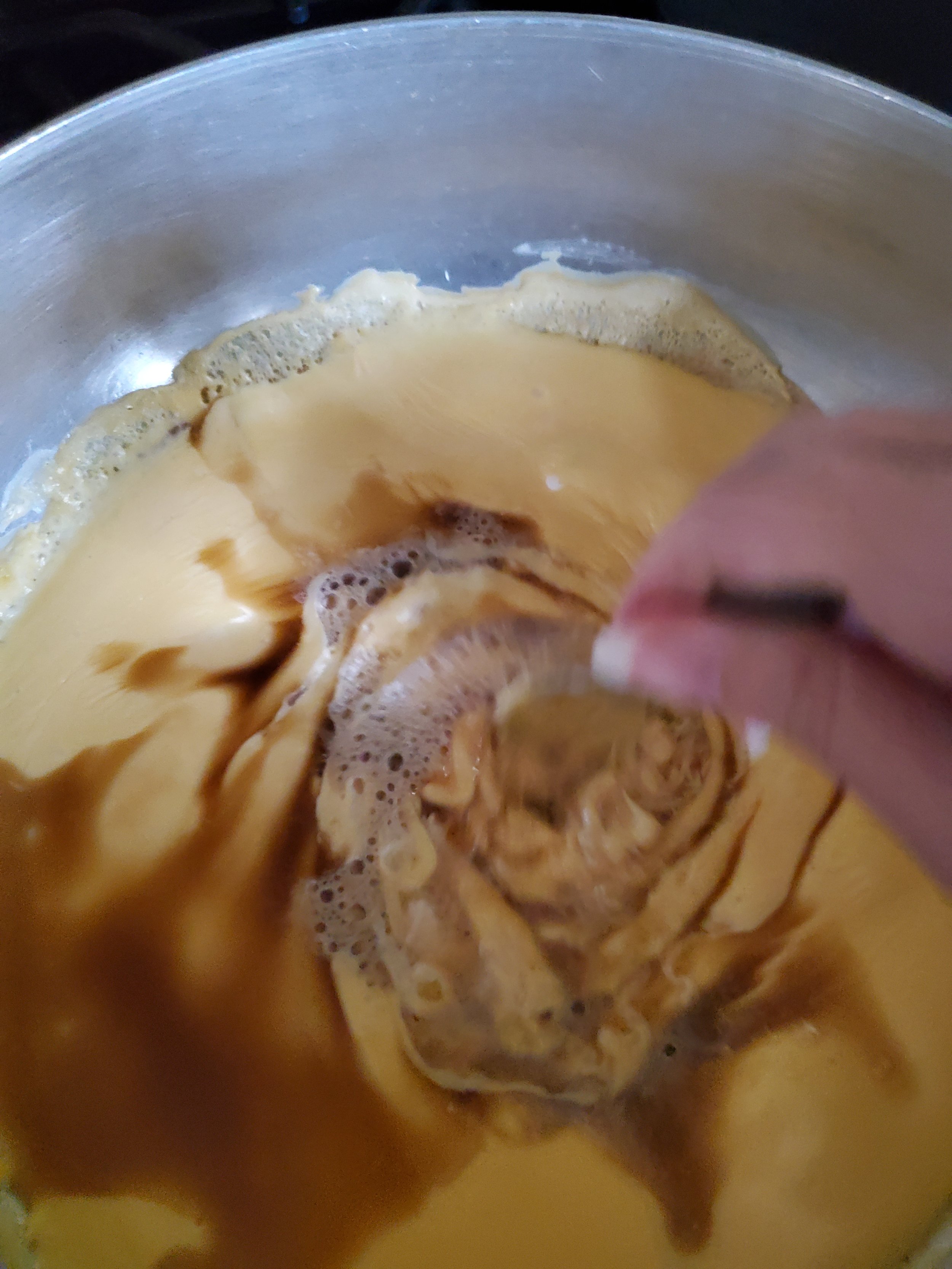
Adding in the beer is going to be an ugly and kind of gross looking step. The beer will foam on contact and turn the top layer of cheese into a bubbly, brown, goopy mess. Ignore this and push on, stirring until it's incorporated. It's worth it, we promise. You'll know when it's incorporated fully because the cheese itself will have darkened about two shades, and there will be no dark or foamy pockets left.

Now comes the mustard. We used Plochman's brand stone ground mustard because it's super coarse and chunky, and it's a really LOUD mustard flavor, but even just the Great Value brand will add significant taste and texture. On a slight tangent, Plochman's also offers a craft beer mustard made with pale ale - so if you're looking for more beer flavor and less mustard flavor without sacrificing the bite, you can definitely look into that. (No, Plochman's is not giving us any money for this - they just make really good mustard. We promise.)

Mixing the mustard in is going to take some time. It naturally wants to keep to itself in little chunks, but you'll want to break it up so every bite of your beer cheese has enough, but none of them are overtaken by it. Just keep stirring until it looks like it's even. And then stir it a little more, just to be sure.

Once you're satisfied with the distribution and mustard to cheese ratio, grab a pretzel or a cracker and scoop a little beer cheese onto it try it. This is a vital step - very, very important. You can't serve it to your friends or family without quality control, after all. And no one knows better than you if it will need your own special touch - a little white pepper or cayenne? A dash of hot sauce? A sprinkling of Parmesan? Garnish with parsley? Run with it. It's yours now.

Serve it as a dip with pretzels, crackers, or pita chips; use it as a spread on a sandwich or burger, sauce your chicken wings with it, work it into a meatloaf... We've even eaten it as a sauce over pinto beans. Once you've tried it, you'll have a dozen other uses for it right away. Trust us.


Adding cream to the beer cheese.

Now it’s officially beer cheese, we’ve added the beer!

And now we have added the mustard and the beer cheese is complete!

Why Should I Purchase A Steam Oven?

Pros and Cons To A Fantastic Kitchen Appliance


How often have you been faced with choosing between a junk meal you can cook quickly and a delicious meal that takes time? Exactly. We all face that problem time and again. Many of us face it several nights a week. There are entire industries built around how to avoid this very problem. Someone got sick of the idea and figured out how to invent a steam oven. Speed ovens take advantage of cooking quickly and thoroughly, without losing all of the taste and nutritional value of your food.

"Wait blogger," we hear you say* "we've been using steam for ages, that's not any faster than any other way of cooking." And you're right. Just steaming your food isn't particularly fast. Humans have been using steam for ages, so long in fact that historians bicker over who solved it first. Was it the Chinese who wove bamboo steamers? Or was it the people who would end up becoming the French, the Auriganeans who used wet leaves and embers? We're left asking 'why does it matter who did it first if both figured out how to make tasty food?' We might be biased though. Either way, you have food that is introduced to a wet environment, where the water is heated by application either of boiling water or directly by fire and cooked. You can use steam baskets made of bamboo or metal, or you can use double boiling where you place two pots that fit well together where the bottom pan is full of water and the top pan is heated by that boiling water, but no water comes into contact with the actual food. (Fun fact: Chocolate is melted best in this fashion so that the chocolate doesn't seize and become grainy and gross.) 

A steam oven though is an oven which either cooks just by using steam or has an additional steam function on top of other more 'standard' functions that it can switch in between. 


Steam oven with fish and vegetables, showing the reservoir.

Why Do I want a Steam Oven? 

You might want to purchase a steam oven for several different reasons. 

a) As a replacement for a standard stove.  

    If you're looking at replacing your current oven already, looking at the various functions you'll use or need makes sense. With a steam oven that has multiple modes, you can do many different things and incorporate steam into your life a little at a time. 

b) An addition to your kitchen, such as purchasing an on-the-counter steam oven. 

If however you're not sure about a steam oven, but you want to test it out, you might get a countertop one. This way you can take your time learning to use it and how to adjust recipes you already love to it. 

c) If you're doing a full dietary overhaul. 

While we won't say this can't fit into the other two categories, this is one that we think can also stand on its own as a reason to purchase a steam oven. As we mentioned already steaming your food can lead to tastier food that retains the natural vitamins and nutrients. 


Steam oven reservoir

Pros and Cons of Steam Ovens

Pro: You don't need to use oil with a steamer. The steam oven retains moisture both in and around the food as it cooks. This means that the food can't stick as easily to surfaces. (We will note though that this feature only works if you make sure to fill your reservoir before you cook each time.) 

Con: You're not going to get super crispy skin or browned foods. Because those reactions both rely on a 'dry' heat the steam oven can't provide that. (Unless of course, you're working with a multi-function oven like this one from Jenn-Air.)

Pro: Your foods retain more of their nutrients because they aren't leaching into cooking water or oils. Have you ever been told that baking broccoli or carrots is healthier than boiling them? The nutrients leaching into the cooking water is the reason for that. The majority of the vitamins and minerals end up in the water rather than in your stomach. 

Con: This doesn't mean that all of your food is instantly better for you because it was cooked in a steam oven. ((We know, we hoped it would make delicious breads healthier too.)) 

Pro: If you choose a full-sized oven with a steam feature, you can cook multiple foods at once without the flavors blending into each other. 

Con: There is a learning curve in adjusting or coming up with recipes.  (Fortunately, there are plenty of people over on Pinterest with recipes just for cooking with a steam oven! ) 

What do you think? Will you be looking into getting a steam oven sometime soon? Let us know what you think or some recipes you love over on our Facebook page. We'd love to hear from you. 


If you ended up on our site because your current steam oven is broken, we're sorry to hear that! We can still help. Appliance Rescue Service works on all major appliances and we'd be happy to work on yours. Just give us a call at ((214) 599-0055) or visit our website at https://appliance-rescue-service.com/contact-us to make an appointment today. 


* yes, we can hear you through the vast reaches of the internet in terms of this post. 


What Appliances Do You Need For a Tiny House?

And Which Can You Cut Out?

If you’re looking at building your own tiny house, either as a real estate investment, as a space for guests, or just as a home away from home, appliances are something to consider. Due to their very nature, a tiny house can’t handle full-size appliances for every single type of appliance. The question then becomes “well, which ones do I need to keep, which ones do I get rid of, and which ones can I get in smaller sizes?” Those questions are where we come in. For this post, we’re assuming that this is an actual ‘home’ with a kitchen of some sort, not just an extra bedroom, office, or hobby space. So let’s dig in and find out just how much you can squish into a tiny home! 


Dishwasher

We’re biased, we’ll admit this up front. To us, a dishwasher is a must-have. Fortunately, you can get dishwashers of all different sizes. You can have a full, cabinet size, or even drawer sized dishwasher. 

Full dishwashers usually measure in at = 24 x 35 x 24 (Lx Hx W

A ‘thin’ or ‘cabinet’ dishwasher typically measures about = 24 x 18 x 24

While a drawer dishwasher is a bit more flexible in its size, this one from Fisher & Paykel was 24 x 17 x 23. 


Sink

A sink is another nonnegotiable, but that’s due to food safety as much as anything. Especially if you give up having a dishwasher, you’re going to need somewhere to wash food, pots and pans, and your table settings. Not to mention all the other ways we use our kitchens. To us this is another one where you can’t really skimp, and we advise getting a double basin sink. However, if you just don’t have the space, the smallest kitchen sink we could find is this one from Kohler, which is 15 x 15 x 9. 


Refrigerator 

Refrigerators are one that you absolutely could get away with, but only under certain conditions. If you’re going to live mostly off of vegetables you eat the same day you buy them, or pantry staples, we could see that working. There are also several different sizes available, with the absolute smallest refrigerator being able to hold no more than a few cans of soda. For practicality’s sake though, let’s assume that you want a small, under-the-counter refrigerator. A good brand to look at here would be something like RCA. They have several different sizes and versions of mini-fridges. 

Freezer

Freezers are... Complicated. On one hand, if you’re not going to have a refrigerator, you will probably want a freezer of some sort for long-term food storage. You can also get a normal side-by-side or top and bottom refrigerator/freezer combination unit if you’re willing to give up the space for one. You can also get an under-the-counter freezer or a chest freezer. The benefit to a chest freezer is that you get right into the habit of a tiny homeowner, using a space for multiple things. Depending on how large a chest you get, you can put it to work as a table as well as storing food. Keep in mind though that you can’t put too much weight on the top or it can cause the lid to bow, ruining the seal. So it can be done, just check the manufacturer’s guidelines with your particular freezer. 


Washing Machine

In our Deep Dive on Washing Machines, we showed you many different varieties of washers, how they work and what makes them different from each other.  We stand by what we said then about all-in-one washer/dryers being an option, although not one we would typically suggest.  Instead, if you’re looking for something, we would suggest getting a standard or even a small washer. 

A standard washing machine is typically = 28 inches or 2 feet and 4 inches wide

A small washer might come in at = 20 or 21 inches.


Dryer 

For a dryer, this is entirely dependent on how much energy you want to spend on a regular basis. You could use a clothesline outside in good weather, and then a hanging system inside in cold or poor weather. Or you can get a dryer and have to find a way to work around it for space consideration. Like we mentioned in our Dryer Deep Dive, you’ll have to have double the amount of space in your dryer that you do in your washer or else you won’t be able to effectively dry everything from a single load. 


Stove

Here is where you really get to be creative. Options for a stove replacement are many and quite varied. It really comes down to how creative you can get. You could even replace many of your pots and pans, freeing up cabinet space for other things if you plan it right. With one or two multifunction Instant Pots you could replace the need for 90% of your pots, as well as a stove. 

Other options include one or two electric burners, which make for a portable stove. This way if it’s not in use, you can store it away. You can also use slow cookers to great effect, although we will point out that you can get an Instant Pot with the same function built-in. 


Oven 

Here again, you get to play around and get creative. Do you want a full oven? Or would you rather devote that space to cabinets? Do you have a wall that would otherwise be unused that you could install a built-in oven into? What about a toaster oven that doubles as a rotisserie? Toaster ovens can be surprisingly large and serve remarkably well as replacements to a standard oven.  


When it comes to outfitting a tiny home, it proves to be as much of a creative puzzle as the rest of the house is. What can you give up? What can you live without? What do you have to have in order to accomplish the basics of life? Let us know in the comments below or over on our Facebook page. We want to hear from you--what could you live without OR how have you structured your tiny home? 


If on the other hand your kitchen has gone kaput or your washing machine has washed out, we’ve got your back. We can repair any and all of your major home appliances whether it’s full size or meant for a tiny home.  You can get hold of us by calling us at ((214) 599-0055) or you can set up an appointment on our contact page.  


Additional Reading
Washer Deep Dive

Dryer Deep Dive


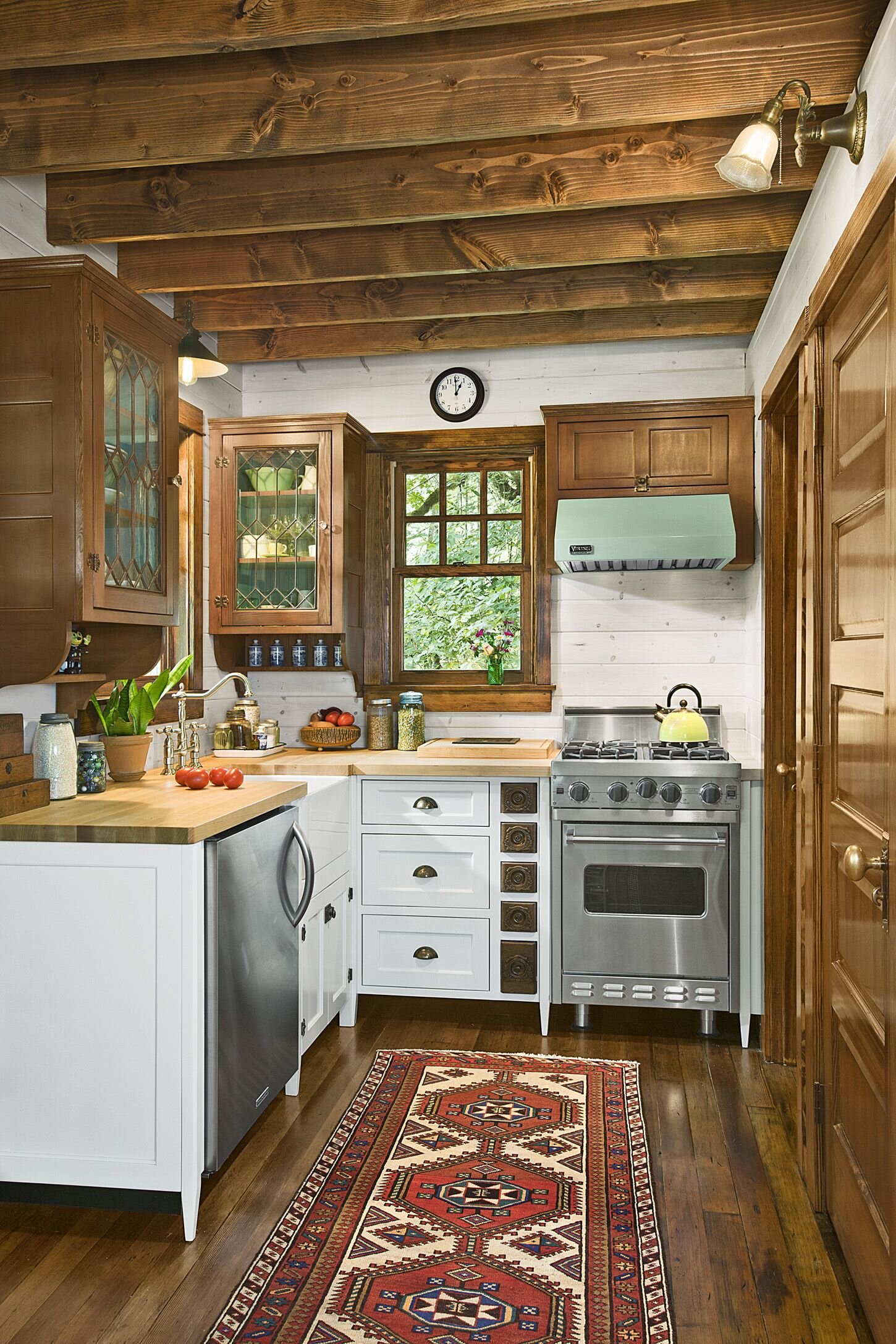
This tiny kitchen has a small oven and an under the counter refrigerator. Instead, they opted for a large farmhouse sink to make cleaning up easy.

This tiny kitchen has a small oven and an under the counter refrigerator. Instead, they opted for a large farmhouse sink to make cleaning up easy.

This tiny home on the other hand has a full size sink, but no oven whatsoever. It has just a stove top, as well as an interesting pull-out counter at the end.

This tiny home on the other hand has a full size sink, but no oven whatsoever. It has just a stove top, as well as an interesting pull-out counter at the end.

This example has a smaller sink, but they have a full oven and stove top built into the cabinet, along with a vent hood.

This example has a smaller sink, but they have a full oven and stove top built into the cabinet, along with a vent hood.

How an Appliance Repair Service Call Works in 2021

What we’ve changed to keep you safe.

Table of Contents

Before Your Appliance Repair Service Call

During Your Appliance Repair Service Call

After Your Appliance Repair Service Call

 Have you ever been fed up with how difficult it is to find a good appliance repair service? Or gotten vague answers on what goes into an appliance repair service call? We're fixing that today. Although we've covered what went into them before, that was before Covid-19, which feels like it was forever ago. 

 Before, it was a matter of giving us a call, setting up the appointment and waiting for us to  fix your appliances. Our technicians would come by and talk with you while they worked and figured out what had caused your appliance to break. All of these are still part of the process, but, they're not the only parts. 


Now though, whether it's with us or with others, there are health precautions that we all have to observe. Wearing face masks if a client requests it should be a standard part of how things work, regardless of who you decide to work with, and all of our technicians are well versed in it. For your safety and that of our technicians we do ask that you stay outside of the room while they're working, this way safe social distance is maintained. 


Now imagine that you have the day off and you're trying to get caught up on your laundry. Except your dryer isn't working. It's started making a strange humming sound while it's running, and you can't find anything about it on the internet. Other people have had this same humming dryer issue, but they don't know how to fix it either. What do you do? 

Before Your Appliance Repair Service Call 

- Do NOT Unplug the Appliance(s) 

We appreciate it, we really do, but we need to see and hear the appliance so we can understand what's going on. Unplugging the appliance can mean that we miss specific sounds that help identify problems. In our example, if you unplug it, and all we have to go on is your description of the humming that the dryer is making, we're in trouble. What sounds to you like an "Aahhhhhhaahhhh" might sound to someone else like an "Ooooohhhoooo." Does it make that much of a difference? Surprisingly, yes. Many times a sound or tic of an appliance might not pop up until it has been running for a while. So turning it off is "resetting" it in a fashion. That doesn't mean that it fixes it though. 


- Set Up An Appointment

When you give us a call, we'll work with you to find a time that works. While you're on the phone is the best time to schedule a look at all of your appliances. If our technicians are already at your home, why not roll all of your problems into one visit? By scheduling everything at once, you can save yourself time and money. Rather than having to schedule multiple appointments over several weeks, you have the chance to have everything checked or repaired at once. This means that everything is on one bill, problems can't be given the chance to get worse, and you give up one block of time rather than several. You can also ask for us to do maintenance checks on your other appliances which can lead to discovering issues before they can become serious problems. 


-Clear the Path to Your Appliances

Now that you've got your appliance repair call set up, what's next? Time for popcorn and a movie? Not quite. In order to be able to help, we need to be able to get at your appliances. So before we come to visit we need you to clear away anything around, on top of or behind your appliances. Whether it's just one appliance that you're asking us to fix or multiple that you want us to check on, we need access. If you can go through and move around things so that we can access every side of the appliances, you've made our lives MUCH easier. We're going to be looking for anything and everything during your service repair call so the less there is for distractions, the better it is. Tying this back to our example case, in the event of your dryer making a humming sound, once you take everything off the top of it, it can change the pitch of the sound that your dryer is making. It can become louder, or quieter, depending on what you had on top of it. 


During Your Appliance Repair Service Call 


-Ask Questions About What Happened 

Something is going on in your appliances. You now have a captive expert to ask all of your questions. The more questions you can ask, the better prepared you are for next time and can nip it in the bud. It also means you can ask about other things that bother you about the appliances in question. If you've put multiple appliance calls together you can also ask questions to find out about the others. 


- Request Maintenance Tips 

Just like they can offer explanations on your problems, our technicians can also offer tips for preventative maintenance. What can you do to prevent problems or prolong the life of your appliances? If you have questions about one type of maintenance over another, whatever, we want to hear it. 


-Ask Questions About Your Appliance Warranty

You know the giant manual that came with your appliances? Or the link that you were sent after purchasing it that's full of legal jargon? Yeah, that. 


We know a large number of people don't bother reading them, and we don't blame you! 

But once again, you've got an appliance repair expert at your home. Stay outside the room and stay masked, but ask all the questions that have been bothering you. How long are the motors covered vs the drum? What about the electronics? In the event that we don't know off the bat, we can find out. 


-Ask Questions About Your Appliance Warranty With Us

Yup! Appliance Rescue Service gives you a warranty as well. We've got the full explanation of what that is down below, but if you have questions while we're there? Go right ahead and ask. We want you to be comfortable and trust your neighborhood Appliance Rescue Service.  


After Your Appliance Repair Service Call 

-Feedback & Review

We want to know how we did, not just so that we can fix any issues you have, but also so that we can do better in the future. Did all of your questions get answered? Did our techs remember to give you your written estimate of the work?  We want to hear from you. You can call us at ((214) 599-0055) to let us know or set up an appointment today. Or you can go to our contact page to set one up. We hope to see you all again next week. 


Additional Reading: 

Freezer Deep Dive

Warranty With Us (the Run Down) 


When you book an appointment with us, we will send an expert technician to your home, and give you a complete written estimate that includes all parts and labor required.

Your technician is often able to provide you with life expectancy, preventative measures, and periodic maintenance that may help you decide whether or not to proceed with a repair.

Our diagnostic trip charge fee is $75.00

Each part we install, and its related labor is warranted for 90 days of normal household use. Technicians use factory new parts on all repairs unless you have chosen otherwise.

If any part we install in your appliance fails during your warranty period, simply give us a call! We will quickly replace the defective parts at no charge!

Each part we install, and its related labor is warranted for 90 days of normal household use. Technicians use factory new parts on all repairs unless you have chosen otherwise.

30 DAY WARRANTY ON LABOR

If any part we install in your appliance fails during your warranty period, simply give us a call! We will quickly replace the defective parts at no charge!

repair-man-3030870_1280.jpg