Ravioli Alla Caprese

 Proving that delicious pasta is absolutely possible to make at home.

This week’s recipe is all about Italy.  Delicious ravioli is a comfort food when many of us need a little comfort. What are you supposed to do though if you can’t get out to the store? It’s a really complicated thing to make right? Well actually, no. The only thing that’s complicated about the dough is the need to balance ‘enough’ mixing versus ‘not enough.’ Once you’ve got that, the rest is easy. 

Ingredients

For The Dough: 

1 cup water

¼ tsp kosher salt, plus more for the pasta water

2 ½ cups all purpose flour plus more for dusting 

For The Filling

1 cup whole milk ricotta cheese, drained

¾ cup finely grated mozzarella or mild sheep’s milk cheese

½ cup freshly grated Parmigiano-Reggiano cheese

½ tsp dried oregano

1 large egg

½ tsp kosher salt

For The Sauce

3 Tbsp extra-virgin olive oil

2 cloves garlic, smashed and peeled

1 25-ounce jar tomato puree

3 springs basil, plus torn leaves for topping

1 4-inch piece Parmigiano-Reggiano cheese rind, plus grated cheese for garnish

¼ tsp kosher salt 

To make the dough: Grab a small saucepan and put in on high heat, bring the water and ¼ teaspoon salt to a simmer.  Place your flour in a medium sized mixing bowl. Pour the hot water over the flour and mix together using a  silicone spatula or a wooden spoon. Continue mixing until it becomes a shaggy dough. Dump the mixture out onto a lightly floured surface and knead the dough for 5 minutes or until smooth and elastic.  Wrap your dough with plastic wrap and let it rest for 10 minutes on the counter. 


While that’s resting, let's make the filling.  In a medium bowl, mix together the ricotta, mozzarella, Parmigiano, oregano, egg and salt. 

To make the sauce: Take a clean pot and heat it over medium heat, add the olive oil and garlic. Cook the garlic for 2 minutes, or until the garlic is lightly browned and aromatic. Pour in the tomato puree, the basil springs, the cheese rind and a bit of salt. Let the sauce simmer for 12 minutes, stirring often. When the sauce has thickened slightly, remove and discard both the basil and the cheese rind.  

Roll your pasta dough out on a lightly floured surface to a ⅛ rectangle 6 inches by 36 inches. Place little mounds of the filling (roughly 2 teaspoons each) of the filling at an inch apart on the long edge of the dough. Fold the dough in half long ways, covering the filling and carefully press around the filling sealing the dough. 

Cutting apart the dough can done in two different ways. You can use a glass or a cookie cutter if you want round ravioli.Or you can cut them apart using a knife if you want square ravioli. Remove any scraps and repeat. You should end up with roughly 30 ravioli at the end of the process. 

Put a large pot of water on high heat and season liberally with salt.  Once it’s boiling, it’s time to start cooking. Add the ravioli in batches and simmer for about 3 minutes, or till they float. At that point you’ll know they’re cooked through. Using either a ladle or a slotted spoon, remove them from the pot. To serve, ladle spoonfuls of sauce to the center of a plate and position the ravioli on top.  Sprinkle with grated Parmigiano and torn basil. 


Notes: 

Let’s start with this “what the heck does ‘alla Caprese’ mean??” In this case it means in the style of Capri, which is an island off the western coast of Italy. The style of Capri is (almost) anything made with tomato, basil, olive oil and mozzarella.  

Now, if you want to make this process even easier you can go into your freezer and grab out an empty ice cube tray. Next, lay the dough over the tray and carefully push the filling into each of the wells. Fold the other half of the dough over the top, as in the original instructions and use the walls between the wells to press together the two layers of the dough. Finally, flip the tray over onto a lightly floured surface and using a sharp knife cut about the cubes. If you want to get really nifty you can even take a fork and press down the edges both to make sure they’re firmly attached and also to make them look nice. 

Additions to the filling- You most definitely can add to the filling, but make sure that if you do that the additions are small in size.

Some good examples for additions might be: mushrooms, ground beef, Italian sausage, crab, prosciutto, chicken, or sweet potatoes. 

Let us know how it goes! We want to hear about your attempts and how they turn out, either here in the comments below or over on our Facebook page. 

Don’t forget, if you want to schedule a check up for your appliances, that is something we do! You can also count on us to help fix them if they’ve been rude enough to break on you. We don’t stop until the job is done right. You can reach us by phone ((214) 599-0055)or by making an appointment on our website. 

Tradesmen: How To Find The Right One For Your Home

A General Guide for Locating Trustworthy Skilled Labor

When was the last time you had your toilet overflow? Or a fuse burn out in your house? If you’ve had it happen we bet you can’t remember it too well. What about when you had to wait around for a plumber or an electrician to come out? We’ll bet you remember that. It tends to stick with you when it messes up your day, having to reschedule and work around their time tables instead of what you have to get done.  We all hate the hassle, but what can you do about it? That’s the price of doing business right? 

To a degree, yes. Some jobs take longer than others and you can’t help it. On the other hand, you can choose who you hire and make sure they have a good reputation. To help with that we’re going to give you our four steps for finding the best people to trust to come to your home, just like you trust us. 

It’s best if you can do this when things are calm and working well at home, rather than when you’re in a bind. This way you don’t have to worry if something breaks, you’ve already done the groundwork. All you’ll have to do is call them up and say ‘Hey, do you have time to fix this?” 


Finding Your List

Let’s start with finding them. There’s pros and cons to each of these methods but they are reliable. Starting off, don’t rule anyone out, just take down names and companies, and rates if you can find them. We’ll worry about crossing them off later. 


Google

Your go to search engine will, depending on your settings, find people in your area.

The downside to this is that business can pay to be in certain sections of that front page. If you look closely at a Google search, whether you’re on mobile or desktop, you’ll see a section that says it’s an ad in small print. 

Below and (sometimes) above that is going to be people who have ranked for that page by having a good reputation and marketing skills. At least as Google’s algorithm decides currently. 


Google Maps

Closely related, although not the same, is the Google Maps app. Again you have business that paid to be seen first and then you have ones that are actually near you. If you’re looking at maps it’s going to be based on which businesses are closest to you rather than who has the best reputation. 


Facebook

Facebook has a business section that can be utilized as well. You probably knew that though. Did you know that you probably shouldn't trust the reviews on the page though? Skip down to the bottom of the post to find out why.

Here you’re going to be given results based 90% on how close a business is to you. Or their defined service area overlapping with where you’ve told Facebook you live. The other 10% is going to be how well their most recent posts match what you decided to search. 

Something to keep an eye on is how many followers does a business have? While that’s not a foolproof indication, it is a mark in their favor. 


Friends, Family and Neighbors. 

Unless you live in a rural area (which if you’re one of our clients, you probably don’t) you have people that have dealt with the same problems you have. Everyone has plumbing issues, or their HVAC going out in the middle of summer. (All you have to do is look at Facebook or Twitter to see it.) So ask them. Who did you use? Who would you avoid? Why do you say that? (That last one is very important as we’ll get to soon.) 


Ways to Check Them Out 


The Better Business Bureau 

This is a good first place to start.  What’s their rating? If they’ve got lower than an A, it’s smart to put them lower on your list, but don’t count them out just yet. 


Angie’s List  

If you haven’t heard of Angie’s List, it’s a fantastic site that verifies everything they put on their site. Businesses, reviews, everything. They even do background checks on the businesses and rate them based on how they’re doing.  This is our favorite for hunting down companies when we need something fixed because their grading system isn't’ a flat grade, but instead is based on professionalism, responsiveness, price, punctuality and quality. 

Screenshot from Angie's List showing Appliance Rescue Service's Score


Nextdoor

We can’t describe Nextdoor better than they have themselves: “Where neighbors exchange recommendations for babysitters, plans for local events, and tips about what to order at that new cafe down the street. Where local agencies connect with neighbors in need. Welcome to Nextdoor.”  It’s a great place to check out what others in your area are saying about a place and to get a recent picture of how a place is doing. You can get as specific or diverse as you like. Here you’re able to ask further questions of your neighbors even ones you might not have met yet. 


Questions to Ask 

We’ve been telling you to ask questions and you’re probably getting annoyed that we haven’t said which ones, right? 

You have your basic ones, that all of us know to ask a company. 

  • Can you fix [Insert Your Specific Problem]. 

  • What types of payment do you accept? 

  • Can I do a payment plan? (We like this one if the problem is insanely complicated and if it ends up costing an arm and a leg.) 

You have the more complicated ones you ask them. 

  • Do you offer a free estimate?  

  • How busy are they and can they work with your schedule? 

  • How does a typical appointment work? 

  •  Do they offer service packages? 

If you were to ask all of these of us, our answers would be 

question-marks courtesy of qimono
  • If it’s a problem with one of your appliances, we’ll do our best to fix it. If we don’t know how, then we’ll learn and we won’t stop trying to fix it until you tell us to stop. 

  • We accept cash, check or 

  • Nope, we don’t offer free estimates because we value your time and ours. Instead we will diagnose the problem and give you a written explanation of what to expect. This includes all parts and labor. Your technician is often able to provide you with life expectancy, preventative measures, and periodic maintenance that may help you decide whether or not to proceed with a repair. 

  • Yes, we do work with your schedule! 

  • To read up on what a typical appointment looks like, check here

  • As of right now we don’t offer service packages, although we might in the future. Check back often! 


And then you have the ones you ask people who recommended them or advised against them. 

  • Do they railroad you into doing things you don’t need?

    • We’ve all heard of carpet salesmen or auto repair shops that do this to you. It’s one of the reasons we make sure to ask this, because who wants to deal with that? 

    • Did they explain what was going on or how they planned to fix it? 

    • If you did or didn’t like them, why? What happened? 

      • This one is more important that it might seem. Some people might not have liked something trivial “the repairman forgot to wipe his feet off.” Or it could be a much larger issue “I had something go missing the day they came.” Knowing why someone gave a bad review is just as important as the fact that they did. 


Take Reviews With a Grain of Salt 


With that last question  we come to something very important. With the exception of Angie's List (which we recommended for just this reason) people can say anything they want. They could feel insulted over how the repairman spoke, when really they just had a head cold that day. 


Do you feel better prepared for finding a tradesman for your home? Are you less worried about what’s going to happen next time something breaks? We hope so. If you have any questions, comments or ideas for what questions we can answer next, please let us know over on our Facebook page. We’d love to hear from you. 


Don’t forget, our technicians are always here to help you. We want to keep your home running in a smooth fashion. If something’s broken, it’s not working quite right, or just if you want us to come and give you some maintenance tips, we can do all of that for you. All you have to do is make an appointment on our page. 


The Five Most Common Types of Clutterbugs

And How You Can Deal With Them…

Are you a clutterbug? Do you live with one? Are you tired of it? While there are deep psychological reasons for people being clutterbugs, there are still practical ways to deal with the clutter. The question is: what type of clutterbug are you dealing with? 


The Pack Rat

This clutterbug is the type to keep EVERYTHING. Stuffed in every available nook and cranny are the things they collect or keep because it’s useful. 

How to deal with this: 

Computers, boxes and other odd items stacked haphazardly.
  • Make a plan. Don’t just say “I’m going to tackle the living room today!” No. Break it down a) in a way that makes sense to you and b) is small enough you won’t get overwhelmed. 

  • Go slow. Again the point here is to make sure that you can emotionally tackle this not just physically. 

  • Consider the system of ‘Keep’, ‘Toss’, and ‘Donate.’

    • Keep - If you cannot part with it either because it’s useful or important. 

    • Toss - It’s broken and you don’t know how to repair it or don’t have time to learn how. 

    • Donate - You don’t want it or it’s not useful to you, but it could be useful to someone else. 


The ‘Archivist’ 

Letters, magazines, newspapers, books, all forms of the printed or written word are valued by this clutterbug. Their home is full of stacks and shelves. It may be sorted, it might not. 

How to deal with this: 

Stacks of letters and newspapers scattered

  • Sort by type. Start by figuring out how much of each item you have. Sometimes, seeing just how much of something you have makes it easier to select out what to keep. 

  • Cull out any duplicate items. Two of a book? A magazine? Set them aside either to recycle or donate. 

  • Scan it! Letters, magazines, newspapers, recipes etc. There are several different scanning apps that can be used to save and store material items against degradation or loss. (This blogger favors Evernote personally.) 

  • When it comes to books, if you’ve only read it once, put it aside to be donated. Why keep it if you don’t enjoy it? 


Landing Zones 

 These are the people who collect clutter in specific places. Maybe it’s a table near the entry door. Or a chair in the bedroom. Or the dining room table. It doesn’t matter, these spots are catch-alls. This type of clutterbug will drop the contents of their pockets or purse here, mail, clothes they want to wear later, etc. 

The best way to work with this is to: 

Purses hung on and around a rack.
  • Create ‘no fly zones’ or areas where things can’t be. 

  • Block those areas  with something. It could be a cute pillow, a tray or  a vase, something that clearly says ‘this is not a place to drop things.’ It’s just meant to be a trigger to help you change how you view that space. 

  • Include areas where it is ok to put things, but that you have to sort it out once a week. 


The Abundance Clutter 

This clutterbug isn’t what you might think. Their home is mostly clean. They don’t have obvious clutter. But if you go into the kitchen and open up their cabinets and pantry... That’s when the image changes.  This clutterbug buys things on sale that they don’t need. They buy surplus ‘just in case something happens.’ Six or seven of one type of chips. Boxes upon boxes of Rice a Roni, which lets just say you should NOT eat this way for months upon months. 

How to deal with this:

Pantry stuffed full of repeated materials.
  • Make a meal plan. Go through what you have already and decide what you can use soon, what you will use within a month or can store for 6. 

  • Go to the store next.  Ask yourself, will I eat this within the next 3 months? 3 months is a healthy middle ground between ‘saving for the future’ or ‘just in case’ and ‘buying only what you need for this week.” Buy only what you will use within that time period.

  • Check yourself before you go to the counter. Make sure that you haven’t grabbed more than what you need. 


Organizing Only When Things Are Messy

This is the type of clutterbug that leaves things slowly building up. One day at a time, until there isn’t any space left. Coffee cups, plates, mail, magazines, Everything! 

And it stays that way until one day they realize how messy everything is and they burst into a cleaning frenzy. 

Repeat ad nauseum. 

For some people this works just fine! For others it becomes far too much. Or it could be the spouse, friends or family of this clutterbug. 

How to deal with it: 

  • Dedicate 10 minutes a day to clear. Just pick up anything that you can and put it away. 

  • Dedicate time every week to sort through and put away other things that built up over the week, or to organize your home. 


So we ask you again, are you the clutterbug? Or are you the one living with the clutterbug. Either way we hope that we’ve helped you to see a way forward that doesn’t involve huge time commitments or trying to turn your personality inside out.

What about you? What are some techniques that you’ve found that work for you in corralling the clutter? Let us know on Facebook. Remember, we’re not just here to help you keep your home clean, but to also make sure that it runs smoothly. If you’ve recently found that one or more of your appliances aren’t working properly, feel free to reach out. You can call and schedule an appointment or  go to our website and schedule one there. 

Down Home Comfort with Sweet Tea-Brined Pork Chops and Red Pepper Relish

So good your guests won’t want to leave. 


This month’s first recipe is one that’s perfect for the dog days of summer. It doesn’t take much to prep and it’s easy to throw on a grill to cook. So many of us already drink sweet tea in the summer, we decided to try it in other uses as well. We came across this idea and after testing it out, it’s a winner!  Try out our Sweet Tea Brined Pork Chops and Red Pepper Relish.

Ingredients

8 orange pekoe tea bags*

1 cup sugar

6 bay leaves (preferably fresh)

1 Tbsp coriander seeds

6 bone-in center cut pork chops (2 inches thick; about 5 lbs total) 

3 red bell peppers, chopped

1 large vidalia onion, diced

2 Fresno chile peppers, seeded and chopped 

¼ cup apple cider vinegar

¼ cup apricot preserves

Freshly ground pepper

Kosher salt

Vegetable oil, for the grill 


-Make the brine: Bring 6 cups of water to a boil in a large pot. Turn off the heat and add the tea bas and let steep for 10 minutes. Discard teh tea bags. Stir in ¾ of a cup sugar, ½  cup salt, the bay leaves and coriander seeds. Cook over low heat, stirring consistently  until the sugar and salt are dissolved. Roughly 3 minutes.  Remove from the heat, pour into a  large heat proof pitcher and set the pot aside for the time being. Let the brine cool to room temperature, roughly 30 minutes. Refrigerate the brine until very cold, at least one hour.Pour the brine into the reserved pot and add the pork chops. Cover and refrigerate for at least 8 hours, or overnight. 


-Once the brine and pork is in the fridge, make the pepper relish. Put the bell peppers, onion and chilies in a food processor and pulse until broken down but not pureed. This should be 2 or 3 times on most food processors.  Transfer to a small saucepan and add the vinegar, preserves, the remaining ¼ cup of sugar and ¼ tsp of salt. Bring to a boil, then lower the heat and simmer until slightly reduced, but still juicy. Keep a close eye on it as time may vary based on time of year. It should take about 10 minutes. Remove from the heat, transfer to a serving bowl and refrigerate until you’re ready to serve. (You can make the relish up to a day ahead.) 


Preheat your grill to medium. Oil the grill grates lightly. Remove the pork chops from the brine and pat dry. Season the chops with salt and pepper. Grill, covered until well marked, roughly 14-16 minutes. If they get too dark, rotate them 90* . Flip the chops and cook, covered until well marked on the other side. Take a digital thermometer and insert it sideways into the center. It should register 145* and at that point it’s done. Transfer the pork to a cutting board and let it rest for 10 minutes. Serve with the relish. 


NOTES 

*Or the equivalent amount of loose leaf orange pekoe, if you’re willing to use it. 


So what is orange pekoe exactly? 

Rather than a flavor, orange pekoe is actually in reference to the quality of the tea. 


Tea leaves are picked from different heights on a plant for different purposes. The younger the leaf, or the higher it is on the plant, the more flavor it has. Another matter that goes into grading is how whole or broken a leaf is after it has been processed and dried. So an orange pekoe tea is made up of whole, young leaves. 


That’s not to say that the bagged tea you can pick up at your local store isn’t perfectly good tea. This is just the actual definition of an orange pekoe. So, no your pork isn’t going  to taste like oranges, unless you add some into the brine. 

Tea plant with leaves labeled based on the different tea grades.


Did you ever wonder what the difference was between a jam and a relish?

We did while making this recipe. A relish, according to Britannica, is a cooked and pickled vegetable or fruit preserve. It’s typically eaten with a bland food to bring flavor, but we can promise that’s not the case with this dish! 


Thank you very much for joining us for this recipe. We hope you enjoy cooking it as much as we did. Which was your favorite part? The tea brined pork or the relish? We’d love to hear from you over on our Facebook page. We want to see how yours turned out. 


If you found out that your stove or refrigerator weren’t working properly while you were making this, don’t hesitate to give us a call. 


Whether it’s your refrigerator or stove, your ice maker or your dryer, we fix appliances. And if all you want is to schedule a maintenance check? We can do that too. 


We look out for our clients in Allen and the surrounding areas and we want to keep your home running in tip top shape. 


Call us at ((214) 599-0055) or schedule an appointment on our website

4 Kits Your Home Needs

The Bare Bones For Your Home

We put together four kits that will get you through almost any situation. When you’re starting out somewhere new you don’t always have everything you need, or the funds to get it. Whether you’re a business exec moving to a new state or fresh out of college with your first apartment, you tend to pare down. Whether it’s a last minute get together, a broken outlet, or you cut yourself fixing said outlet, we’ve got you covered. 


Let’s talk about the most common type of kit first, the first aid kit. 

Ideally, you should have several around your home. This way in the event of injury you don’t have to go far for what you need. Some of these, like bandaids, are going to make sense. Others, like splint material will confuse many. “We live in the first world. Shouldn’t I just go to the hospital or call an ambulance?”

Well, ideally, yes. What if it’s a major holiday though? Or there’s rough weather, you can’t get out or it’s going to be a while until a paramedic can get to you? In those cases it’s better to have all of this on hand and know how to use it. 

One last one you might not have run into before is lavender essential oil. This can be used on burns and other small wounds, and is kept in many a metalworker’s kit. 


FIRST AID KIT 

Aloe vera gel

Medical Scissors

Nonadhesive dressing

Medical tape

Rolled gauze bandages

Splint material

Lavender oil 

Anti-inflamatory drugs

Anti-bacterial ointment

Ace bandages

Surgical scrub brush

Disinfectant wipes

Sterile compress

Selection of bandages

A first aid kit list
 

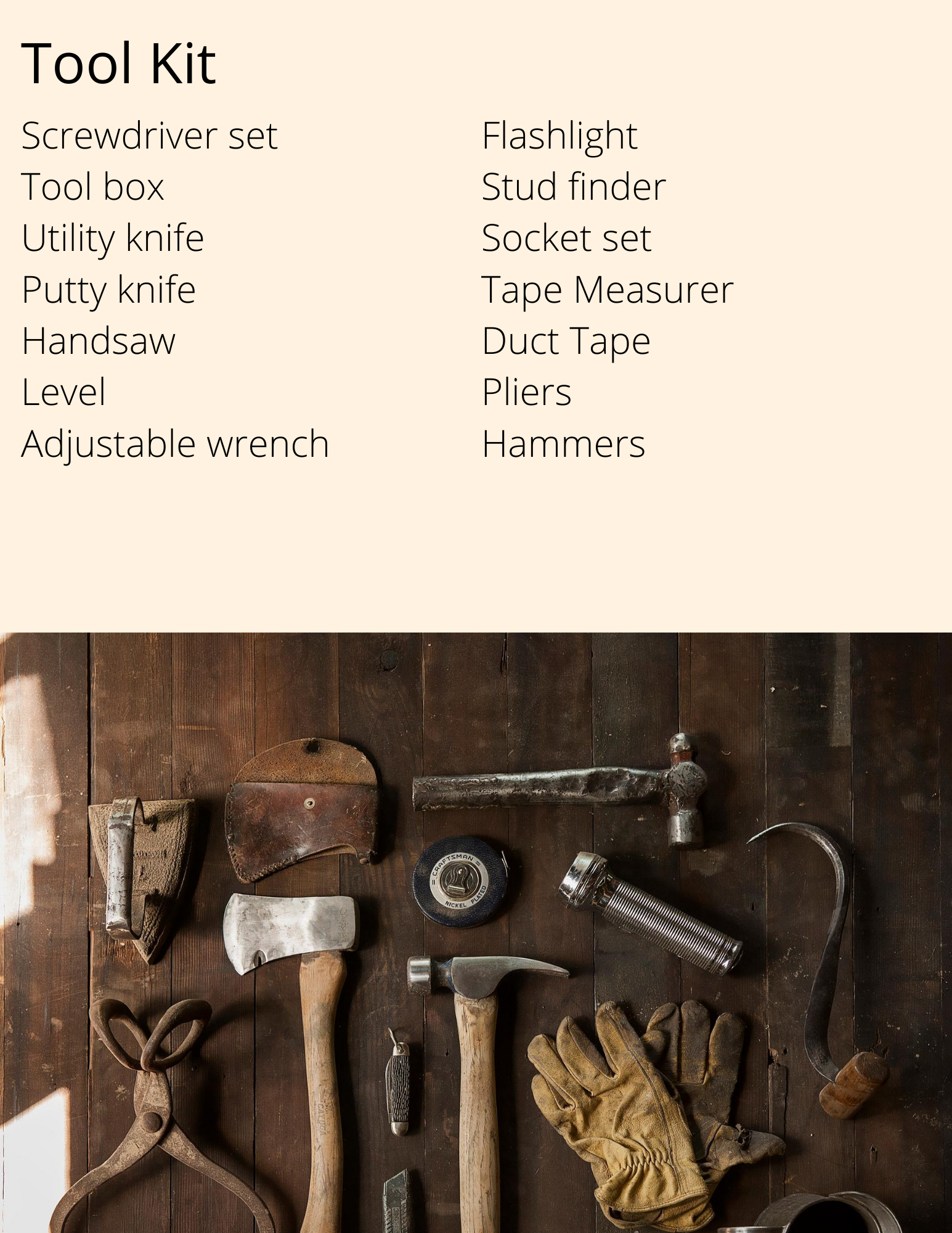
TOOL LIST

Next up is tools. This isn’t the type of stuff you get for Father’s day.  This is meant to be a “multipurpose, used everywhere around the house, if you don’t have the ‘right’ tool, see if one of the others will get the job done.” That sort of kit. (Not that we have any issues with the nicer or more specific tools, but this is a basics post. 


Screwdriver set - a mix of Philips and flat-heads, or even a multihead screwdriver. 

Tool box- Even if it’s a small kit, it's easier if you can keep everything together. 

Utility knife

Putty knife

Handsaw

Level

Adjustable wrench

Hammers - One 16 lb claw and a small mallet

Duct tape

Pliers - You can pick up a set with a channellock, needle nose and side cutting pretty easy. 

Flashlight

Stud finder

Socket set 

Tape measurer 

A list of basic tools you need around the home.- to fix anything.
 

The Kitchen

Moving into the kitchen, we have more tools, but this time, we’re focused on making food. While we love our specialty tools like our automatic pan stirrers, crepe pans and multi function blenders, in truth you don’t need them. We know, the horror. Really though, with these 10 tools and persistence, you can make any dish. Is it easy? Not always. But you’ll also have less clutter in your kitchen. 

10” Stainless Steel Skillet

Chef’s Knife

Measuring Spoons

Dry & Liquid Measuring cups

Cutting Board

Sheet Tray

8 Quart Heavy Pot

Peeler -  Either a Y peeler or a straight peeler will work. It’s up to you which you prefer. 

Large Spoon 

Fine Mesh 6” Sieve 

A list of basic kitchen tools you need to cook almost anything.
 

The Pantry

Moving on from the tools in the kitchen, you have basic supplies. We saved this list for two reasons: 

  1. It’s the longest

  2. It’s broken into 4 parts

The idea here is that by keeping all of these items regularly stocked in your home, you can put your hands on any of them when you need them. Last minute guests? No big deal, bulk up what you were already making for dinner. Your child has a bake sale that they only told you about now? Easy!

Things like fresh fruits, vegetables, dairy and meats aren’t included because they spoil at different rates, and everyone has different food needs. Adjust the lists as needed and as will work for you/your family. 

Common/ Dried Baking Herbs and Oils Freezer
Pasta Baking Soda Vegetable Oil Frozen Spinach
Tomato Sauce Baking Powder Coconut Oil Frozen Green Beans
Lentils Cornstarch Canola Oil Frozen Peas
Peanut Butter Brown Sugar Olive Oil Frozen Corn
Canned Soup White Sugar Dried Onion Frozen Carrots
Potatoes Shortening Whole Pepper Frozen Broccoli
Canned beans Chocolate Chips Garlic Powder
Rice Flour Basil
Canned Chicken Yeast Oregano
Mixed Nuts Cornmeal Dill
Cereals & Oatmeal Paprika
Canned Mushrooms Celery Seed
Canned Broth Sea Salt
Mixed nuts Cinnamon
Dried fruit Chili powder
Basil
Cayenne
Vanilla Extract
Cocoa Powder
Cumin

Common/Dried - These are the foods that will last and last and with just a  few you can throw together a delicious and filling meal.

Baking- These are the core ingredients for most baking recipes that you should always have on hand. 

Herbs and Oils - You don’t need a large amount of herbs in your cabinet in order to bring flavor to your dishes. With 16 spices you can evoke flavors and places all over the globe. (Although we get it if you want to add to your spices any time you can. We do the same.) 


Freezer- Easy to keep on hand, they don’t spoil and you can bulk up any meal  by adding them in, frozen veggies are the best! 

A list of items needed in your pantry, and a line of spoons with different ingredients on them

These four kits are ones we think are essential, but what about you? Do you think we missed some? Or just an item or two? Let us know in the comments below or over on our Facebook. We’d love to hear from you. 


While we talked about the whole home this time, don’t forget that we’re also here for your appliances needs. If your  appliances are acting up, or you want to schedule a maintenance check, feel free to reach out via phone or our appointment page. We want to help all of our clients in Carrollton and the surrounding areas.

The full set of all four lists so you can purchase all of them in one shopping trip.