
Because the thing that cleans your dishes needs cleaning, too.
Have you ever opened your dishwasher to find that it smells sort of weird, or that your dishes are still dirty? It might be because you haven’t washed your dishwasher. That seems like a logical thing to do regularly, but you’d be surprised at what people do, or don’t do, with their dishwashers. For example, our technicians have told us about customers cleaning car parts and cooking in theirs. So, while washing your dishwasher might sound a little odd, it’s just like anything else that we use for cleaning: it has to be washed to stay clean and get rid of gunk. The most important spots for this are the filter and the door seals, but we’re going to walk you through the benefits of regularly cleaning your dishwasher, how to clean it, and when to clean it.
Why You Should Clean Your Dishwasher
There are three major benefits to regularly washing your dishwasher. The first is reducing unpleasant odors, for your sake and that of your family and guests. No one likes a smelly kitchen. The second is better dishwasher performance and cleaner dishes. If the dishwasher can’t breathe around mold, limescale or debris, how is it supposed to clean properly? And the third is that it helps prevent breakdowns and costly repairs, since debris that gets past the filter can build up in the drain pump and limescale can clog the spray arm holes, until the dishwasher stops draining or cleaning properly.

How to Clean Your Dishwasher, Step by Step
The very first step in cleaning your dishwasher is to find your User Guide, either online or where you stored it after getting your dishwasher. This will tell you what type of dishwasher you have and what to expect with it, especially any unique features that need to be removed in order to clean it.
Second, make sure that your dishwasher is fully empty. This doesn’t just mean removing any dishware. It also means you want to remove the racks from the dishwasher. This is the first time we are going to point out that you need to look to your manual. Some dishwashers make this extremely easy: you just lift the racks out and you’re done. Others have caps which need to be removed, and some still need screws taken off in order to get the racks out. Next, you’re going to want to take out the spray arm, if it’s possible.
Your third step is to get a microfiber cloth or a brush, along with a 50-50 mix of water and vinegar. Heat the mixture in the microwave until it’s hot, making sure to use a microwave-safe bowl, and use your tool of choice to get into the fittings and grooves of your door to get rid of any gunk, grime, or bacteria. Make sure to wipe again with a clean rag and plain water, so the vinegar doesn’t sit on the seal any longer than needed.
For the fourth step, you’ll want to look to either the corners or the base of your dishwasher for the filter. Once again, we’re going to take a look at your manual, for three reasons. One is to find out if you do have a filter. Two is to see what type of filter it is. And three is to find out how you’re going to put it back together. Always make sure that you know how to put the thing back together before we disassemble it. Once you’re positive you understand the instructions and that you actually have a filter, go ahead and remove it.
At this point you might have one of two types of filters that are currently common on the market. The first is a fine filter. These are typically an insert and a flat mesh filter. You can wash this under hot running water with a toothbrush and some dish soap. The second option is a microfilter, and these are typically cylindrical with a cap on top of them. These will twist to come out of their housing. Again, washing under hot running water, removing any food or debris from the filter, and scrubbing with a toothbrush is the go-to method. If there is any buildup of limescale on your filter, now is a great time to also utilize the vinegar from before: soak your filter for a few minutes, then scrub and wash. Once your filter is clean, reference your manual, make sure that you know how to reassemble it, and replace it within your dishwasher.
For your fifth step, take that microfiber cloth from before and use what remains of the water and vinegar, heating it up if necessary, to wipe down the baskets and the spray arm. If it’s necessary, use a toothpick to clear any of the holes on your spray arm, as blocked water is going to make things difficult and your dishwasher less efficient.
Step number six is to reinsert the spray arm and the racks, place a dishwasher-safe bowl with fresh white distilled vinegar on the top rack, and run your dishwasher empty on the hottest cycle available. This step is to get rid of any final debris or limescale.
The seventh step is to tackle any remaining odors. You’re going to sprinkle a cup of baking soda all over the bottom of the dishwasher and run another cycle on hot.
Your final step, after the baking soda wash, is to leave the door open and let the dishwasher air dry to prevent any mold or mildew. Each of these steps tackles a different aspect of your dishwasher and the problems that can arise just from daily use.
How Often Should You Clean Your Dishwasher?
So how often should you clean it? You’ll want to check your filter and the base of your dishwasher after every load. You don’t have to take the filter out to scrub it, but typically there will be an inset where it is that you can check and just make sure there’s no food or accumulation of yuck. Once a week, go ahead and remove and clean the filter with just hot soap and water. Finally, a deep clean like we’ve walked you through is a good idea once a month. Scheduling this prevents not only breakdowns, but it also means you don’t have to reach into your dishwasher and question, why is this coming out dirty?
A Few Important Notes
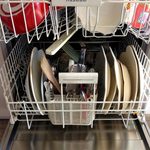
First, if you’re the sort to use your dishwasher for more than dishware, such as cleaning fragile items, car parts (we’ve seen it), gun pieces, or for cooking, you will want to run your dishwasher on a cleaning cycle, or at the very least with distilled white vinegar, and wipe it down after each such use to avoid cross-contamination.
Second, your dishwasher leads to the same drain that a garbage disposal does. So if you have smells or fruit flies coming from your drain and your dishwasher, it’s possible that it is the garbage disposal. However, we will cover that in a later post.
Finally, do not put bleach or hydrogen peroxide in your dishwasher. Many dishwashers, if not all at this point, contain stainless steel, either in part, such as uncovered pieces made of stainless steel, or entirely, such as an entire stainless steel interior. Samsung is a good example, since most of its dishwashers have a stainless steel interior. Hydrogen peroxide and bleach, together or separately (although you shouldn’t combine them, but that’s an entirely separate list of dangers), can erode the stainless steel within your dishwasher over time. So if you don’t want to have to completely replace your dishwasher, don’t do this.
When to Call a Professional
If you have gone through this method and your dishwasher still smells, is not cleaning your dishes properly, or has an extensive buildup of limescale, give Appliance Rescue Service a call. We are experts in handling dishwashers of all brands and models and are happy to work with you to set an appointment that fits your schedule. A dishwasher that isn’t running properly can throw off your whole household, and we understand that. Our expert technicians will not only pinpoint the cause and explain what’s happening, but also fix it so that your home can run smoothly again. You can reach out to us via our website or by giving us a call.
Website
Call : (214) 599-0055