
As the year comes to a close, it’s time to look back at what kitchens were actually asking for in 2026. Not the Pinterest boards or the showroom concepts, but the trends designers and homeowners keep talking about. We’re going to look through a batch of them to see what we think of some of the best, which ones we think will stick around, and which ones we think won’t.
Now, we’re an appliance repair company, not a design firm. But we spend our days in kitchens just like yours, so we have opinions. For each trend, we’ll cover what it is and how it works, what designers say about its upsides and downsides, and then give you our take.
Soft Pastels
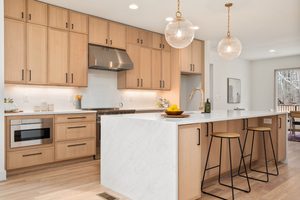
No, we’re not talking about Easter. Pastels are making a return to kitchens in 2026, but not the sugary, candy-colored versions you might remember. These are faded lavender, foggy blue, aquamarine, and the palest celery, colors muted enough that they almost read as neutrals with a little extra personality.
Paint brands are driving a lot of this, and some of the new 2026 palettes were designed to cover entire runs of cabinets, not just an accent wall. The pairing designers keep recommending is pale wood with matte brass, which keeps the look grown-up instead of nursery. The upside is that it’s a much gentler direction than the dark, dramatic cabinet colors we’ve seen lately. The downside, as with any paint-driven trend, is that you’re committing to a color, and some designers warn that a kitchen done entirely in one trendy shade can start to feel one-dimensional or dated.
For soft pastels, we like it. It’s definitely something different than what we’ve seen in the past in the kitchen. But we are concerned that this one isn’t going to last very long. Most paint trends don’t last beyond a few years at most. And this one, while it’s interesting, there’s a reason that it’s never stuck around before.
Textured, Traditional, and Sculptural Hardware
For a time, cabinet hardware became an afterthought, the last thing picked after everything else was done. In 2026, it’s back to being closer to jewelry for the kitchen, and there are three directions happening at once that overlap more than you might expect. The first is texture: knurled brass, hammered bronze, and ribbed or fluted pulls that add character without adding clutter. The second is a more refined take on traditional shapes, like cup pulls, bow pulls, glass knobs, and ceramic details, only less ornate than the old-school versions. The third is slightly sculptural pieces that look collected over time instead of bought as a matching set.
What ties them together is that the hardware should look chosen, not just installed. On the plus side, it’s one of the quicker ways to change a kitchen without touching the cabinets, with budget guides putting the cost at roughly $150 to $300. The cautions are to check the hole spacing on your existing cabinets before you buy anything, and to go easy on very ornate styles, which can look heavy on the wrong cabinets.
Given how long it’s been since the last time that cabinet hardware got to shine, maybe 20 years or so, we think this one will be a trend that will stick around for a while. We’re excited to see this come back, although we highly suggest going out of your way to hunt down secondhand or unique and custom drawer pulls and cabinet handles. This is another one of those ways that you can make your kitchen entirely unique. Why get something that’s the same as everybody else?
Choosing Solid Wood Over Veneer
Wood cabinets are back in a big way, and with them comes a smaller shift: people are starting to ask what the wood actually is. White oak is still the most requested, followed by walnut, and homeowners increasingly want to see the grain instead of painting over it.
Designers are also steering toward solid wood or thick-faced panels instead of thin veneer. Solid wood costs more up front, but it can be refinished and repaired down the road, while veneer is generally less durable. Slatted wood patterns are still around too, usually in measured, repeating sections rather than covering every surface.
This one isn’t really a trend. Solid wood has stayed a preference among many circles. It has only been in new builds where many of us shifted towards using veneers. However, we are very glad to see that the larger group of homeowners are returning to this. We just hope that this time around, more sustainable choices will be made, as we see this one sticking around for a very long time.
Bold, Veined Marble
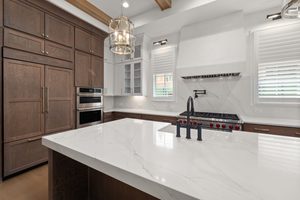
If plain white marble is the little black dress of the kitchen, this is the sequined jacket. Quiet, barely-there stone is still popular, but there’s a louder counter-trend happening: marble with serious personality. Designers are making the veining the star of the room, whether that’s a single slab running the length of an island, book-matched slabs where the pattern mirrors itself across a seam, or stone wrapped down the sides of the island.
Color is part of it too. Deep greens, burgundy veins, and rich browns are showing up where plain white used to be the default. The upside is that one dramatic slab can make a kitchen feel high-end without you having to splurge on everything around it. The downside is that a statement piece is, by definition, hard to blend in, so designers tend to keep the cabinetry around it fairly simple.
This is another trend that goes back and forth. We are really excited to see it come back around. Having bright, bold colors in the kitchen and celebrating the natural stones that exist. This is a gorgeous way to punch up your kitchen and draw all eyes that come in. We hope this one will last, but as with many trends, it will swing back and forth with time.
Glass-Front Cabinets
For a while, open shelving was the look everyone wanted. Then everyone remembered they’d have to dust it. Glass-front cabinets are the middle ground, and designers are leaning in: reeded, hammered, or clear glass in slim frames, usually mixed with solid doors so you’re not putting every mismatched mug on display.
Because the cabinet is closed, your dishes stay visible and within reach without collecting as much dust, and the glass bounces light around, which helps in smaller or darker kitchens. Some designs go a step further with LED strips inside the cabinets, so your glassware glows after dark. The tradeoff is that you do have to keep whatever is behind the glass looking presentable.
We are so grateful that, for the most part, open shelving has gone the way of the dodo. Having to dust shelves like that is a pain in the neck for anyone who has had it, and it never manages to look like your kitchen is clean when you have anything less than perfect curation in your kitchen. And some of us like to have a mix of dishes and cups and all of the kitchen gadgets. So open shelving just doesn’t work. Glass front cabinets are still a bit much. But the ability to bring in hammered or stained glass is absolutely amazing, and we are happy to see this mix up in the kitchen.
Japandi
No, that’s not a typo. Japandi is the blend of Scandinavian simplicity and Japanese-inspired warmth, and it’s still shaping a lot of kitchens in 2026. The look is calm and earthy. Think clay, sand, and stone tones, matte finishes, warm lighting, and natural textures like wood, linen, and honed stone. Cabinet lines tend to run low and horizontal, and paper-shaded pendant lights are a signature touch.
A close cousin, Wabi-Sabi, goes a step further by celebrating wear and imperfection instead of hiding it. Both styles are about kitchens that feel quiet and lived-in, rather than showroom-perfect. The caution, according to some designers, is that a room built entirely from one soft neutral can end up feeling flat, so texture and contrast matter.
Japandi and Wabi Sabi are both very interesting styles. And we’re excited to see how designers take it. To see how homeowners use it in their everyday lives. And to see who really makes a change. However, like many culturally based trends, we don’t see this sticking around for more than a season or two.
Curves
Hard edges are on their way out, and if you’ve ever caught a hip on a sharp island corner, you won’t be sad to see them go. Curved islands, arched doorways, rounded cabinet corners, and even softened range hoods and hardware are showing up in 2026 kitchens. Designers say curves make a kitchen feel less institutional and more like a place where people actually live.
There’s a practical side to it too: a rounded island helps traffic flow around the room, has no sharp corners to catch you when you’re rushing, and makes seating easier. And unlike a lot of trends on this list, this one isn’t brand new. It has been building for a couple of years now.
As with so many of these trends so far, curves are back! We are excited to see the curves coming back into home design in general, and the kitchen especially, because pointy cabinets hurt. Additionally, if you remember our article on kitchen zones, round shapes are easier to move around and flow through. And that is an important thing when it comes to working within your kitchen as an actual kitchen or entertaining area. We hope this one sticks around for a while.
Multipurpose Islands
The kitchen island has a bigger job description than ever. It’s no longer only where you chop vegetables. Designers describe islands that double as a home office, a bar, a storage hub, an entertainment spot, and the place everyone ends up when company comes over. Some are growing upward as well as outward, with built-in shelving that adds storage without closing the room off.
That said, not everyone is sold on the supersized version. Some designers say the oversized island has become more about looks than function and can get in the way of the kitchen’s flow, and they’re pushing toward smaller, furniture-like islands that can even be moved. What both camps agree on is that an island should earn its space.
And this is one that we are actually a little confused by. As we were under the impression that Kitchen Islands had always been multi-purpose. And the idea of them serving only one purpose seems a bit strange. So it might last. We didn’t know that it had ever left?
Personalization Over Passing Trends
If there’s one theme running underneath all of this year’s trends, it’s that people are tired of cookie-cutter kitchens. Designers keep describing kitchens built around how a household actually cooks, eats, and gathers, with custom sizing, finishes picked for the people who live there, and details with a story behind them. Semi-custom cabinetry is helping make this possible, since it lets homeowners add bespoke touches without paying full custom prices.
Interestingly, even the professionals who work with trends every day are saying the smart move is knowing when not to follow one. One note of caution from a cabinet hardware company: if you’re remodeling with resale in mind, finishes with broad appeal are the safer bet.
We’ve discussed the growing concept of personalization within your home over the last 2 years, and it’s finally hitting the kitchen. Your home should be personalized and customized to you. Your kitchen is the same way. How you move, how your family functions, where you gather versus where you tend to stay away from. All of these things will affect how your kitchen flows as much as what takes the most wear and tear and what should be the biggest highlight visually. We’re happy seeing more people who are willing to once again make their homes their own.
Dedicated Stations and Appliance Garages
Coffee bars, drinks stations, hidden prep zones: kitchens are increasingly being divided into areas built around the way you actually live, and one design roundup calls it one of the biggest layout ideas of the year. An industry report backs this up, listing intentional zoning among the trends with real staying power.
The newer twist is how visible those stations should be. Some designers say a counter covered in coffee gear looks cluttered, and they’d rather see the whole setup tucked behind cabinet doors or into a walk-in pantry or scullery, where the practical parts of the kitchen stay out of sight. So the idea of a station is popular. The question is whether it lives out in the open or behind a door.
That brings us to appliance garages. No, you can’t park the car in one. An appliance garage is a cabinet, usually with a pocket door, that hides the countertop gadgets you use every day, like the toaster, the coffee maker, and the rest of the crew. Close the door and the counter looks clear, then open it when you need something.
Designers are building them into the kitchen itself and into pantries sized to fit the exact appliances the homeowner owns, which one designer described as a quiet sign of luxury. Their popularity ties into a bigger push to clear the counters and keep the working parts of the kitchen out of sight.
If I use an appliance every day, why would I hide it somewhere inconvenient? We’re not fans of this. Because ultimately, out of sight is out of mind. And either you end up not using the appliance, like that fancy coffee maker, or the blender, that you hide away, or the doors never get used, because you’re constantly using your appliances. It just doesn’t make sense.
Panel-Ready Appliances
Panel-ready appliances are built to disappear, which is a neat trick for something the size of a refrigerator. Instead of a stainless steel front, a panel-ready fridge or dishwasher gets a panel that matches your cabinets, so the whole wall reads as one smooth run. The idea has already moved beyond fridges and dishwashers: wine storage that slides under an island with a cabinet-style front, and even refrigeration designed to look like a piece of furniture. The reasoning is that kitchens now double as living rooms, so the appliances shouldn’t shout.
The downside is the planning. Designers warn that the cabinetry, appliance specs, and timelines all have to line up early, especially on a remodel. And a few designers say the fully hidden, ultra-sleek look is already starting to feel a little anonymous.
One trend that we do like, though, is panel-ready appliances. While we don’t like the idea of hiding away your appliances, panel-ready appliances blend in with the kitchen. And the distinction there is that it creates a unified whole instead of having pockets that stand out, which means that anything that you have around the kitchen, whether that is specific colors or patterns or even the sculptural hardware that we talked about earlier, those things get to stand out instead of your appliances drawing the eye.
Heritage-Style Range Cookers
No, it isn’t an antique. Heritage-style range cookers are for the cook who loves a classic look with modern technology inside. They keep the old-fashioned charm, with cast-iron doors and timeless colors, but add advanced insulation, precise temperature control, and even Wi-Fi so you can manage the heat and schedules from your phone.
One manufacturer describes the appeal as the best of both worlds, and it fits a bigger shift toward traditional, handcrafted kitchens with serious technology hidden underneath. It’s worth noting that this one comes from a single source, and it’s the manufacturer’s own description.
Given how far stoves have come, although the heritage-style cookers are interesting, we don’t see them becoming widely adopted or having staying power.
Which 2026 Kitchen Trends Will Last?
That’s a lot of kitchen. Some of these trends will still look right a decade from now, and some will be a ‘remember when?’ photo by next spring. Either way, it’s interesting to see where design is headed, and a few of them might be worth trying in your own home.
But no matter which trends make it into your kitchen, the appliances in it still have to work. Trends and fads aren’t what we do. Keeping your appliances running smoothly is. When a fridge starts warming up, a dishwasher stops draining, or an oven won’t heat, it can throw your entire home out of whack, and dinner is suddenly running late.
Kitchen trends may come and go, but the appliances you rely on every day still need to work. Whether your refrigerator isn’t keeping things cold, your dishwasher won’t drain, or your oven refuses to heat, Appliance Rescue Service is here to help.
ARS provides appliance repair and maintenance in the Dallas area, with scheduling designed to work around your household’s needs.
Call (214) 599-0055 to schedule service.