
How each type works, what’s good and bad about it, and the three that stand out.
Every year, new and different types of stoves come out. But at their core, there are 5 main types of stoves. This week, we’re looking at what those five are, how they work, their pros and cons and the three that stand out.
Gas Ranges
Gas ranges are the most straightforward of stoves. You turn the knob, the ignition sparks the flame, and you adjust it to whatever you need, so you can sear, boil, or simmer in seconds. The downsides start with the installation. If this is your first gas stove, you may need a gas hookup. Gas is also the most annoying type to clean because the grates have to come off and be scrubbed of every bit of debris. While many people would point out that it is the least energy efficient, it can also be the most cost-effective. Let us break that down for you. While only about 50% of the energy reaches your food, with the other 50% dissipating into the air, a gas line costs 10 to 30% less than electricity in most states in the US. And while efficiency and cost aren’t the same, they do factor into any choices you make, especially if you already have a gas line in your house. Gas burners, as we’ve mentioned before, do release emissions, so having proper ventilation on while cooking is always important. In exchange for these downsides, though, you get a visible flame with hands-on, immediate control. And this is why gas remains the preferred choice in professional kitchens. Cookware: you can use pretty much anything that can sit level on the grates, and gas has the advantage here. Additionally, if the power goes out, you can still cook on a gas stove by lighting the burners with a match, which electric and induction stoves can’t offer.

Electric Coil Ranges
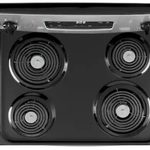
Next, we will look at one of the most common household stoves, an electric coil stove. The upside here is that these are incredibly easy to use and install, and are also extraordinarily cheap. They are very much plug-and-play in many ways, so long as you have the appropriate 240-volt outlet. It’s so simple that if a coil should break, it is possible to remove and replace on your own (although naturally we don’t suggest this one unless you are comfortable). You either turn a knob or press a switch, depending on the model, setting the coil to a specific heat, and then wait for several minutes as electricity spreads through the coil to heat up the metal. The upside is that this is more energy efficient than gas ranges. However, the downside is that it’s both time-inefficient and it’s less precise heating. It’s also difficult to tell when a burner has fully cooled, and most parents just tell their children, “Don’t touch the stove; I just finished cooking.” The cleaning, however, is a bit more difficult. It’s about the equivalent of gas grates, as there are drip pans that you have to get out in order to clean them. Cookware: you can use pretty much anything that can sit level on the coils. However, the downside is that, unlike with a gas stove, this is not going to work during an outage.
Electric Radiant Ranges
Next, take a look at the slightly higher tier and what has become one of the most common types of electric stoves, especially during the 2000s and 2010s: the electric glass stove. These are very sleek and streamlined and fit perfectly in a contemporary home. They are typically mid-tier pricing with all sorts of bells and whistles, but not necessarily the most premium of stoves. Here you have a completely flat stove. They still have coils, but the coils transfer heat through the glass to the cookware, rather than having the coils exposed to pots, pans, and food. So you no longer have to worry about coils or drip pans, but you do have even less certainty of when the surface is hot or not. Some models will include a light or sensor that will show as it cools down, but that danger is still a factor. There’s also the problem that the surface is very easy to crack or scratch if you drop or drag your pans. On the flip side, they are also extraordinarily easy to clean. All you need is a specialized cleaner once it’s come back to completely cool. Again, in comparison of energy efficiency, an electric radiant stove is more efficient than a gas stove, with the downside being that it’s not going to function during a power outage. And it does still heat up the air around the stove.

Glass-Ceramic Induction Ranges
Now let’s take a look at the first wave of glass ceramic induction stovetops. These are separate from an oven and are typically set onto your counter with all of the attached pieces underneath, hidden in the counter space. Induction, therefore, still has a slight lip, and it does break the visual flow of your kitchen. Induction cooktops work where instead of a flame or electricity being applied to the surface and that surface then heating your pan, the surface is inert until a pan is placed on top of it. The copper coils that are under the glass create a magnetic field that vibrates the molecules inside of your cookware. This generates heat directly inside the pan. The electromagnetism turns the pan itself into the heat source needed. This is incredibly efficient, and very little heat escapes into the surrounding air because of it. The downside of glass ceramic induction is that it is still a glass surface. The surface can still be damaged by dropping or scratching, although it is slightly harder than doing it to a radiant heating electric stove. Additionally, with induction stovetops, we run into the issue that unless you already have cast iron pots and pans, you may have to buy an entirely new set of cookware. Induction heating requires a ferrous-bottomed pan or something that is iron-based. A good way to test this, as many will tell you, is to try using a magnet and seeing if it will stick to the bottom of any pans you are hoping will work.
Invisible Induction
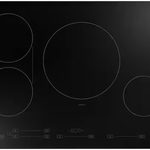
Finally, let’s look at the invisible induction stoves. These take the benefits of the electric-ceramic stoves and remove the drawbacks. Now you have the ease and speed of cooking on an induction surface without any break in your countertop. It appears as though there is just one long piece of countertop with the range controlled either at the front or back of the counter. This means that when the range is not in use, you can use it for food prep, storage, whatever you need. It works by having the coils underneath a specially made porcelain and transmitting the electromagnetism to the pans, causing them to heat. Because it is a porcelain surface, it does not take damage either from dents or scratching the way that glass does. The pans sit on a special silicone mat when in use that protects the surface, so it won’t be damaged by heat. Of all the different ranges we’ve covered, this is by far the easiest to clean, since nothing will burn onto the stove and you don’t need anything different from what you would use on the rest of your counters. Many of the invisible induction stoves also have advanced features, including pan-detection sensors, overheat protection systems, and auto shutoff capabilities. But it is important to point out again that there are only certain types of cookware that are going to function with it. If you have round-bottomed woks, if you have copper pans, if you have aluminum pans, if you have anything that’s not solid steel, or if they are enameled, they are not going to work with an induction stove of either variety. Because of the way that the stoves function, they rely on the electromagnetic properties of the pans. This means that not only is there the upfront cost of getting a premium stove, as these are currently top of the line, but on top of that, the additional investment of all new cookware for whatever you have to replace.

Who Each Stove Is Best For
For our last section, we want to highlight three of the stove types. One is best for passionate home cooks. One is the best reliable price point. And one is for the people who are wanting the most cutting edge or premium upgrade.
For people with a family and a busy weeknight who want a stove they can rely on over and over, that’s going to be the radiant electric stove.
For anyone who is a passionate home cook, who is looking to keep control in the kitchen and have the fine-tuning that is possible with a visible flame, we suggest a gas stove.
And finally, for those who want a next-level kitchen, something that gives you back all of your counter space and is the top of the line, we suggest the invisible induction stove.
No matter which type of stove you have at home, if it starts acting up, it can throw your entire home out of whack. Dinner is suddenly running late if you’re able to figure out something to do at all, and it throws off entire weeks worth of planning. When that sort of thing happens, reach out to Appliance Rescue Service. The number one appliance repair company in the Dallas area. We will work with you and with your family’s timetable to get your home back in order and functioning properly.
Website
Call: (214) 599-0055